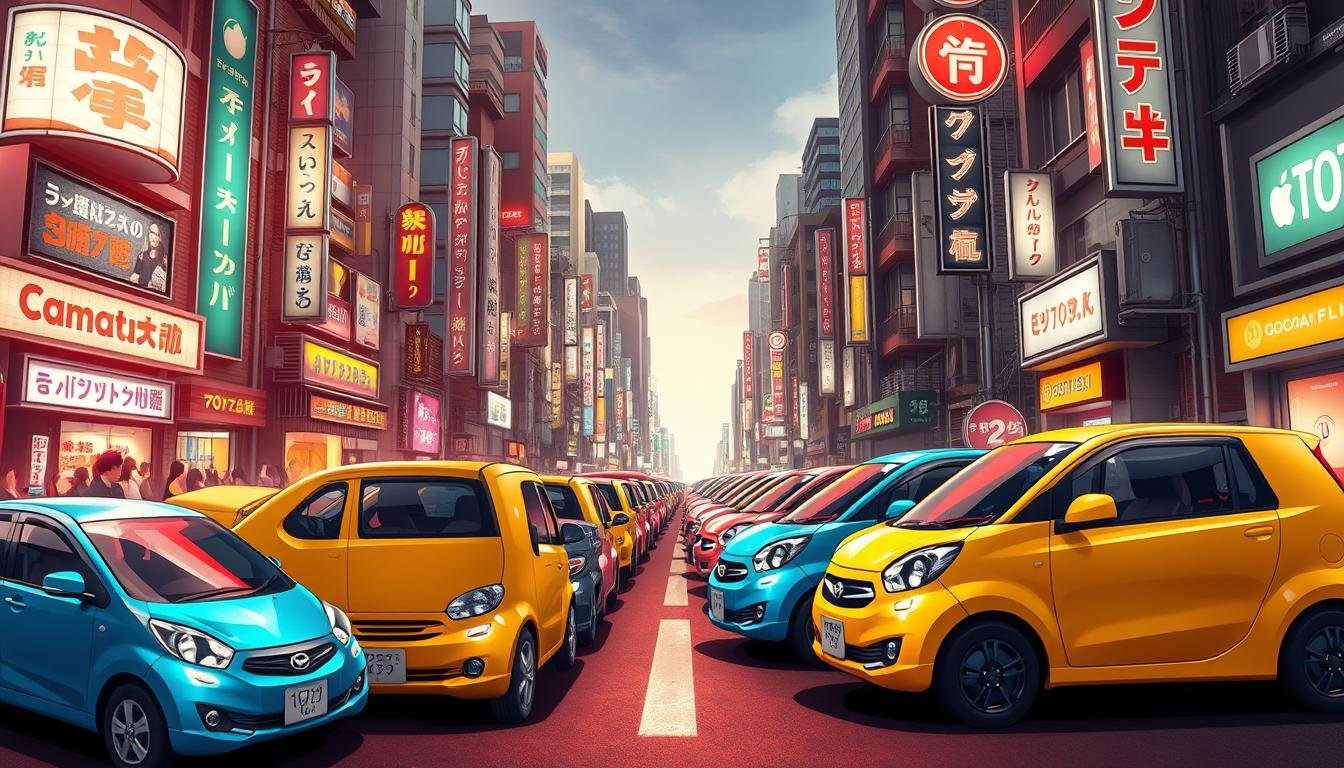

Small Cars, Big Impact: Exploring Japan’s Fascinating Kei Car Culture
Japan’s crowded cities and narrow streets have given birth to a unique car marvel: the kei car. These tiny vehicles, also known as k-cars, are more than just small cars. They symbolize innovation, combining practicality with style to tackle urban mobility issues.
From the Honda Beat’s sporty look to the Suzuki Cappuccino’s turbo boost, kei cars have become a cultural icon. Their 660cc engines and small designs fit perfectly with Japan’s driving habits. Most drivers in Japan cover less than 186 miles a month, making kei cars a perfect match.

At the core of Japanese car trends, kei cars hold a significant 40% of car ownership. The Honda N-Box has been Japan’s bestseller for over a decade, and the Suzuki Spacia is on the rise in 2024. These small cars are not just vehicles; they are woven into the culture.
Yellow license plates mark their tax benefits and fuel efficiency. Even as electric vehicles like the Nissan Sakura gain popularity, kei cars remain a key player in the industry. They offer affordability and adaptability, shaping the future of cars in Japan.
Key Takeaways
- Kei cars meet strict regulations: under 660cc engines and compact dimensions.
- 40% of Japanese drivers choose kei cars for their cost-effective design.
- Models like the Honda N-Box and Suzuki Jimny redefine urban mobility in tight spaces.
- Japanese kei culture influences global markets, with U.S. demand rising for compact vans like the Honda Acty Van.
- Government subsidies and fuel savings make these micro cars a sustainable trend.
The Birth of Japan’s Miniature Automotive Revolution
After World War II, Japan faced a big problem with transportation. The country was rebuilding and had few resources. In 1949, the government made rules for small cars, starting the kei car era. This was a big step in Japan’s car history, driven by need and creativity.
Post-War Origins and Economic Necessities
In the years right after the war, Japan needed cheap ways to get around. The government gave tax breaks for small cars. These cars had to be under 2.8 meters long, 1 meter wide, and have engines no bigger than 150cc.
These rules helped make cars that were both affordable and efficient. The first kei cars, like the Mitsubishi Silver Pigeon, came out. By 1950, the rules changed to allow 360cc engines, helping farmers and small businesses.

Evolution of the Kei Car Concept Through Decades
Over the years, rules changed how kei cars were made:
- 1949: 2.8m length, 150cc engines
- 1950: Expanded to 3.3m and 360cc engines
- 1998: Modern limits set at 3.4m length, 660cc engines
Companies like Subaru, Mazda, and Honda made the most of these rules. The Subaru 360 (1958) sold 400,000 cars, and Honda’s N360 sold 650,000. These cars were all about being small, efficient, and affordable.
How Kei Cars Transformed Japanese Mobility
Kei cars changed how people lived in Japan. They were perfect for the narrow streets of cities. Farmers also loved them for carrying goods.
By the 1960s, kei cars were very popular, making up over 30% of Japan’s cars. Today, they show how small cars can help a country grow economically and culturally.
What Makes a Kei Car? Understanding the Regulations

Japan’s kei cars follow strict rules. These vehicle classification rules guide engine design and size. They make sure cars meet japanese car regulations.
Engine Displacement Limitations
Engines in kei cars can’t be bigger than 660cc. This is up from 360cc in the 1990s. To meet this, makers use small engine technology like turbochargers.
This rule helps keep vehicle tax low and makes cars more fuel-efficient. Cars are also made lighter to use space better.
Size Restrictions and Dimensional Requirements
Kei cars have to fit certain sizes to qualify:
| Category | Max Dimensions |
|---|---|
| Length | 3.4 meters |
| Width | 1.48 meters |
| Height | 2 meters |
These car size regulations help cars fit japanese roads and parking spots. Their compact size lets them have lightweight chassis designs. This makes them agile in cities without losing safety.
The Yellow License Plates: Visual Identification
Yellow plates show kei cars meet the rules. They mean lower vehicle tax and special parking spots. The plates also show engine size and type, proving they follow compact vehicle regulations on japanese roads.
Tax Advantages and Economic Benefits of Owning Kei Cars
Japan’s kei cars are a smart choice because of their tax advantages and cost-saving features. The government helps by lowering japan road tax, saving up to 40% compared to bigger cars. For example, a new Honda N-Box costs around $12,000, which is much less than a Honda Civic.
Car affordability is easy for most families to achieve. Plus, many kei cars get 35–45 MPG, which can cut fuel costs by 30% compared to standard cars.

- Tax Breaks: Kei cars get lower acquisition taxes and automotive affordability perks. Annual japan road tax fees are also halved compared to larger vehicles.
- Lower Running Costs: Maintenance costs are lower because of simpler engines (max 660cc). Low emissions also reduce environmental fees. The Shaken inspection costs 50% less than for non-kei vehicles.
- Fuel Savings: Smaller engines and lightweight designs improve fuel economy. This can save drivers $500–$1,000 a year on fuel alone.
These benefits fit well with Japan’s urban lifestyle. With 91.78% of residents in cities, kei cars are perfect for tight spaces. Their economical transportation appeal attracts fuel-conscious buyers looking for affordable driving. Insurance premiums are also 20% lower than for non-kei vehicles, adding to the savings over time.
These incentives make kei cars a popular choice in Japan. Models like the Suzuki Spacia or Nissan Dayz show how automotive affordability meets modern needs. They prove that small cars can offer big savings without losing practicality.
Navigating Tokyo’s Concrete Jungle: Why Kei Cars Dominate Urban Japan
In Tokyo, where every second counts, Kei cars are the perfect fit for city driving. They are small, making them easy to park and drive in tight spaces. For many, Kei cars are more than just cars; they’re essential for getting around in crowded cities.

Parking Advantages in Space-Constrained Cities
Space is key in cities, and Kei cars are designed to save it. They can park in spots as small as 2.3 meters, while bigger cars need 3.5 meters. This means drivers can save a lot of money on parking, with Kei cars costing 50% less than larger vehicles.
In Tokyo, parking spots can be very expensive. A single spot can cost $20,000. But with Kei cars, drivers can save hundreds of dollars a year on parking.
Maneuverability in Narrow Japanese Streets
“Size matters and on the narrow and overcrowded streets of urban centers, smaller vehicles enable navigation through spaces larger cars cannot.” – Urban mobility study
Driving in Japan is all about precision. Kei cars can turn in just 9.5 meters, while SUVs need 12 meters. This makes them perfect for navigating Tokyo’s tight streets.
A 2023 survey showed that 85% of drivers choose Kei cars for their ability to move easily in tight spaces.
Fuel Economy Benefits in Stop-and-Go Traffic
- Kei cars achieve 35 MPG in city driving vs. 25 MPG for standard vehicles
- Hybrid Kei models reduce emissions by 20% in congestion-heavy zones
- Stop-and-go Tokyo traffic sees Kei drivers saving $800 annually on fuel
In Tokyo, where the average commute is 2 hours, saving on fuel is important. Kei cars are designed to be fuel-efficient, helping drivers save money.
Kei cars are a big part of Tokyo’s transportation scene. They show how well-designed cars can make city living easier. Their success is a testament to Tokyo’s focus on efficiency.
Iconic Kei Car Models That Defined Generations

Starting in the 1950s, certain iconic models have left a mark on Japan’s kei car history. The suzuki alto, introduced in 1961, is known for being affordable. It has gone through seven generations, becoming a tiny classic loved by many.
Its simple design and good fuel economy made it a favorite for years.
- daihatsu move: Introduced in 1989, this hatchback changed the game for kei cars. It offered lots of space and the latest technology.
- honda n-box: Starting in 2012, this MPV-style iconic mini vehicle has been a top seller. It combines sliding doors with a simple design.
- suzuki jimny: Despite its small size, it has been a leader in off-road kei cars for over 50 years. Its 4WD and tough build set it apart.
- daihatsu copen: This two-seat convertible, available from 2002, mixes retro styling with sporty performance.
- mitsubishi minica: A 1970s trailblazer, it’s known for its small size and usefulness. It’s a true tiny classic.
- subaru sambar: A workhorse for decades, its retro kei cars appeal continues in today’s models.
- toyota pixis and nissan dayz: These modern favorites combine the latest technology with timeless practicality.
These iconic mini vehicles show that size doesn’t matter when you have innovation and personality. From the suzuki alto’s long life to the daihatsu copen’s style, each car shows Japan’s talent for making small spaces big.
Suzuki’s Kei Car Legacy: From the Alto to the Jimny
Suzuki has made a big mark on Japan’s kei car scene. Their cars, from budget-friendly to off-road icons, show what tiny vehicles can do. The suzuki alto, suzuki jimny, and suzuki cappuccino mix compact convenience with great performance.

Starting in 1979, the suzuki alto became a symbol of mini mobility. It began with a 540cc engine and now has modern tech. Its light design and 45–70 mpg efficiency make it perfect for city driving, showing tiny but powerful engineering.
The Evolution of the Suzuki Alto
The Alto has changed over five generations, staying under 11.5 ft long. Early models, like the 1984 second-gen Alto, had turbocharged engines. Today, its 660cc engine and 1,962 lb curb weight keep it popular, with prices from $1,000 to $10,000.
Jimny: The Little Off-Roader That Could
The suzuki jimny is small but mighty, with four-wheel drive and 7.9-inch ground clearance. It’s light but conquers trails, winning fans worldwide. Its 64-hp engine and 9-gallon tank offer both off-road grit and practicality.
Suzuki Cappuccino and the Kei Sports Car Revolution
The 1999–2002 suzuki cappuccino changed what kei sports cars could be. With a 660cc engine, it entered the mini sports cars market, competing with the Honda Beat and Mazda AZ-1. Only 1,100 were sold in the UK, making it a cult classic.
| Model | Engine | HP | Years | Key Trait |
|---|---|---|---|---|
| Suzuki Alto | 660cc | 64 | 1979–present | 45–70 mpg |
| Suzuki Jimny | 660cc | 64 | 1985–present | 4×4 off-road |
| Suzuki Cappuccino | 660cc | 63 | 1999–2002 | Mini sports car |
These models show how Suzuki turned limits into strengths. They created vehicles that are tiny but powerful and compact convenient. They prove that small can be mighty.
Honda’s Contribution to Kei Car Culture Japan
Honda has made a big impact on Kei cars. They’ve mixed smart design with a deep connection to Japanese culture. Their work has changed Japan’s car scene in big ways.
The N-Box Phenomenon
The honda n-box changed what we think of compact hatchbacks. It has sliding doors and seats that can change to fit more people. Launched in 2011, it quickly became a top seller.
At the tokyo auto salon, Honda shows off the N-Box with cool

Honda Beat: The Pocket-Sized Roadster
The honda beat (1991–2001) was small but packed a big punch. It had a unique design and a powerful engine for its size. Today, it’s a favorite among car collectors.
Its legacy shows Honda’s belief that small cars can be exciting. People love to restore and customize these tiny cars.
Modern Honda Kei Innovations
Honda’s new Kei cars are full of automotive creativity and the latest tech. They have hybrid engines and advanced safety features. This shows Honda’s commitment to innovation.
At japan car shows, Honda shows off concept cars. They have cool features like self-driving and solar panels. Honda is leading the way in green urban mobility.
Daihatsu’s Creative Approach: Move, Copen, and Beyond

Daihatsu changes the game with mini luxury in the and . These cars show that size doesn’t stop creativity. The is a hit with its and in a body.
It’s a big deal in Japan, with 20% of the Kei market. It’s perfect for families and getting around efficiently.
The brings a new twist to convertibles. Its design and retractable hardtop have boosted sales by 15%. Daihatsu also loves and shows it in the of the Mira Cocoa.
The Atrai/Hijet meets all your needs for a . The Move gets an 85% customer satisfaction score, showing its charm.
| Model | Features | Market Impact |
|---|---|---|
| Daihatsu Move | Spacious cabin, fuel efficiency | 20% Kei market share |
| Daihatsu Copen | Retractable hardtop | 15% annual sales growth |
| Mira Cocoa | Kawaii styling | Top in niche customization |
Daihatsu focuses on and . Their cars are cultural icons. From to , they keep innovating in Japan’s world.
Kei Trucks: The Workhorses of Rural Japan

Kei trucks, or mini trucks, change how we move around in rural areas and cities. They are small but strong, fitting Japan’s strict rules. With a 660cc engine and under 3.4m long, they are perfect for tight spaces.
They help farmers with agricultural tasks and fit on narrow roads. This makes them essential for rural work.
Agricultural Applications and Farm Utility
Farmers in rural Japan use kei trucks for work. Their small size lets them reach places big machines can’t. They carry crops, fertilizers, and tools, helping Japan’s farms.
Urban Delivery Solutions
In cities, kei trucks are great for urban delivery. They can carry packages and tools, even in tight spots. They are better than big trucks in crowded areas.
Here’s how they compare to the Toyota Hilux:
| Feature | Kei Truck | Toyota Hilux |
|---|---|---|
| Length | 5.34m | |
| Cargo Bed Length | 2.03m | 1.57m |
| Max Load | 350kg | 1,500kg+ |
Despite being smaller, they are perfect for city deliveries.
Custom Kei Trucks and Their Growing Popularity
Custom miniature truck mods are getting popular. Now, japanese mini-trucks can even have camping gear like the Bug-Truck tent system. These custom kei trucks are affordable, unlike big Western trucks.
In 2023, over 7,500 were brought to the U.S. They are loved worldwide. But, they are also on Japan’s stolen vehicle list.
Kei trucks are great for farms and camping. They show that being small doesn’t mean you can’t be powerful.
The Art of Kei Car Customization: Small Canvas, Big Expression
Kei car customization brings creativity to Japan’s car scene. These small cars become canvases for personal expression. The customization community is strong online, where car enthusiasts japan share ideas and show off their work.
Platforms like Instagram and forums drive trends. They show that affordable customization is possible, even on a tight budget. Styles like low-riding Shakotan or flashy Grachan are popular.

Custom kei trucks are common in both rural and urban areas. Farmers add practical features, while hobbyists add LED lights or off-road gear. In car clubs japan, members meet to swap parts and enter events.
| Trend | Style | Example |
|---|---|---|
| Shakotan | Low profile, sleek lines | Custom suspension and minimal body kits |
| Grachan | Over-the-top aesthetics | Wide fenders, neon paint, and racing decals |
| Kaido Racers | Performance-focused | Turbocharged engines and aerodynamic add-ons |
Car show culture is big at events like Tokyo Auto Salon. Here, custom features like LED-lit Itasha wraps (anime-themed vehicles) wow the crowd. Even fans worldwide are getting into car tuning, adapting it to their own tastes.
From eco-friendly electric conversions to neon-lit tribute builds, each car has a story. It shows that size doesn’t matter when it comes to creativity.
Quirky and Limited Edition Kei Cars That Captured Hearts
Japan’s kei cars are known for their creativity. Their limited editions and special collaborations make them cultural icons. These small cars mix practicality with bold designs, attracting fans and collectors globally.

Anime-Inspired Special Editions
Car makers have teamed up with kei cars in anime to create limited editions. The Pokémon Edition Suzuki Wagon R is a hit among fans. It features bright graphics and sound effects.
A Studio Ghibli-themed Mazda Carol, with designs from Howl’s Moving Castle, sold out fast. These anime inspired cars turn everyday vehicles into pop culture tributes.
Manufacturer Collaborations and Designer Models
Brands like Suzuki and Daihatsu work with artists on quirky designs. A notable example is Daihatsu’s partnership with Comme des Garçons. They turned the Copen into a wearable art piece.
These unique kei models mix transportation with lifestyle. They become special editions for fans right away.
Collectors’ Favorites and Rare Finds
The Autozam AZ-1 is now worth over $25,000. Its rarity makes it a collector’s dream. With only 1,000 units made, these cute cars are highly sought after.
The Honda Beat from the 1990s and Suzuki’s kei cars designed by anime artists also fetch high prices. They show that even small cars can have a big following.
Kei Car Racing: Serious Competition in Miniature Form

In Japan, kei racing is big, with tiny cars racing hard. These small but mighty cars compete in kei car rallies and speed races. Motorsport Japan hosts these events, where cars with 660cc engines show off their speed.
Events like the Japan Kei Challenge and local time-attack races attract many fans. Drivers tweak their cars, adding turbochargers or custom parts. These changes let the cars go fast, even though they’re small.
| Modification | Impact |
|---|---|
| Engine upgrades | Boosts horsepower within 660cc limits |
| Lightweight components | Cuts mass for faster acceleration |
| Suspension adjustments | Improves cornering at high speeds |
Teams like Honda and Suzuki work on these cars, making them faster. Drivers need to be good at drifting and braking to win. Kei cars are all about skill and power, making racing exciting in Japan.
From Japan to the World: The Growing Global Appeal of Kei Cars
Kei cars are now found around the world, winning the hearts of international fans. Western markets like the U.S. see over 7,500 kei truck imports each year. This is because of their small size and usefulness.
But, getting these tiny cars to other countries is not easy. Their global appeal comes from being affordable and versatile. Yet, there are many challenges in exporting them.

Import Regulations and Challenges
Getting kei cars into new countries is tough. There are several big hurdles:
- U.S. 25-year rule: Cars must be over 25 years old to avoid emissions tests.
- EU homologation: Cars need to meet strict safety and emission rules, which can be expensive.
- Japan’s JDM heritage: Japan has strict rules that limit the export of newer kei cars.
Kei Car Communities Outside Japan
Kei enthusiasts are creating global communities. Online forums and events like the U.S.-based “Microcar Mania” bring car enthusiasts together. These groups are found in:
| Region | Key Activity |
|---|---|
| North America | Facebook groups and SEMA show displays |
| Europe | Rallies and vintage car clubs |
| Australia | Off-road adventure groups |
Collector Interest in Vintage Kei Models
Vintage kei cars like the 1958 Subaru 360 are now highly valued at auctions. Their global interest shows a love for Japan’s postwar creativity. Some of the most sought-after models are:
- Suzuki Fronte: Known for its simple design.
- Mitsubishi Minica: Loved for its retro racing looks.
These cars show the jdm legacy that goes beyond borders. They mix practicality with a rich cultural story.
The Future of Kei Cars: Electrification and Innovation
Automotive innovation is changing Japan’s kei car segment. Electric and hybrid kei cars are leading the way to eco-friendly cars. With better battery technology, makers are pushing the limits of size and weight.
Electric kei cars like the Nissan Sakura and Mitsubishi eK X show how far we’ve come. They use 20 kWh batteries for up to 180 km. Mazda’s ICONIC SP concept and Suzuki’s eWX are also making waves. They show the future of city driving.

Electric Kei Prototypes and Concepts
| Model | Battery Capacity | Range | Price (Post-Incentives) |
|---|---|---|---|
| Nissan Sakura | 20 kWh | 180 km | CDN$17,880 |
| Mitsubishi eK X | 20 kWh | 180 km | CDN$18,580 |
Hybrid Technology Adaptations
Hybrid kei cars aim for efficiency and meet regulations. Mazda’s MX-30 R-EV uses a rotary engine to charge batteries. This makes the most of small spaces. Engineers use light materials to keep the car under weight limits and save fuel.
Autonomous Features in Compact Dimensions
Autonomous driving tech is getting smaller for kei cars. Sensors and processors fit into the car’s design. This makes driving safer in busy cities. Daihatsu’s OSANPO shows how comfort and tech can go together.
Japan aims to have 2 million charging stations by 2020. This supports electric cars. As rules change, kei cars will get smarter and greener. They’ll keep their small size but add new tech.
How Kei Cars Reflect Japanese Values and Cultural Sensibilities

Kei cars show japanese values like minimalism and efficiency. They are perfect for japanese urban life where space is limited. Their small size, under 3.4 meters, reflects a focus on practicality over size.
Their design follows japanese design principles. They look good and work well, fitting into the compact urban lifestyle.
These cars also show cultural sensibilities like avoiding waste. Their small engines save fuel and reduce waste. In Japan, over 40% of new cars are Kei, showing their importance in the japanese lifestyle.
They are affordable, costing around $14,000. This makes them accessible to young families and first-time buyers. They help make mobility more equal.
- Streamlined shapes optimize space utilization for tight parking spots.
- Playful styling blends aesthetic values with practicality, seen in models like the Honda N-Box.
- Electric/hybrid options (10% in 2022) align with Japan’s efficiency focus and climate goals.
Kei cars are a big part of japanese urban life and rural areas. They show cultural innovation and the balance between old and new. These small cars are more than just a way to get around. They are cultural symbols of minimalism and community well-being.
Conclusion: The Enduring Legacy and Influence of Japan’s Micro Motoring Marvel
Japan’s Kei cars show the lasting impact of japanese innovation. They started as a need after the war but grew into a big cultural phenomenon. Their design and practicality came from strict rules.
Over time, these cars became key parts of automotive history. They are known for being efficient and adaptable.
Now, Kei cars are a cultural export that changes how we see cars worldwide. Brands like Honda and Suzuki show that small cars can lead the market. They offer everything from customizable trucks to green models.
These cars keep their global impact by mixing old and new. They inspire people all over the world.
As cities get bigger and we need to save the planet, Kei cars look even brighter. They teach us about making cities better with smart cars. With electric or self-driving tech, they will keep shaping how we move around, blending old and new.
FAQ
What defines a Kei car in Japan?
Kei cars have specific rules. They can’t have engines bigger than 660cc. They also can’t be longer than 3.4m, wider than 1.48m, or taller than 2m. They are easy to spot because they have yellow license plates.
What are the benefits of owning a Kei car?
Kei cars save money. They cost less to buy and own. They also use less fuel, which saves money over time.
How have Kei cars evolved over the decades?
Kei cars have changed a lot. At first, they had 360cc engines. Now, they can have 660cc engines. Their designs have also improved, making them more versatile.
Why are Kei cars particularlty suitable for urban environments like Tokyo?
Kei cars fit well in cities. They are small, making it easy to park and drive in tight spaces. They also fit in special parking spots that bigger cars can’t.
What are some iconic Kei car models that have left a mark on car culture?
Some famous Kei cars are the Suzuki Alto, Honda N-Box, and Daihatsu Move. They are known for their design and innovation. They have become part of Japanese car culture.
How has Suzuki contributed to the Kei car segment?
Suzuki has made big contributions to Kei cars. Their Alto and Jimny models are known for their engineering. The Suzuki Cappuccino even introduced sports car features in a small package.
What makes Honda’s Kei cars stand out?
Honda’s Kei cars, like the N-Box and Beat, are known for their space use and driving feel. Honda focuses on safety and technology in these cars. They meet Japanese consumers’ needs for practical yet stylish vehicles.
Why are Kei trucks important in rural Japan?
Kei trucks are essential in rural Japan. They help with farming and transport in tight spaces. Their small size makes them perfect for rural areas.
How do Kei cars encourage customization in Japan?
Kei cars offer a lot of room for personalization. Owners can modify them to suit their taste. This is made easier by their affordability and the availability of parts, creating a community of car enthusiasts.
What is the appeal of limited edition Kei cars?
Limited edition Kei cars are special. They have unique designs and are often tied to popular culture. They are valuable to collectors and help brands connect with fans.
How is the international interest in Kei cars changing?
More people around the world are interested in Kei cars. But, there are challenges with importing them. Yet, fans have formed communities to share their love for these cars.
What future innovations are expected in the Kei car segment?
Kei cars are going electric. Manufacturers are working on electric and hybrid models. They are also exploring autonomous driving, showing how Kei cars will meet future challenges while staying relevant.