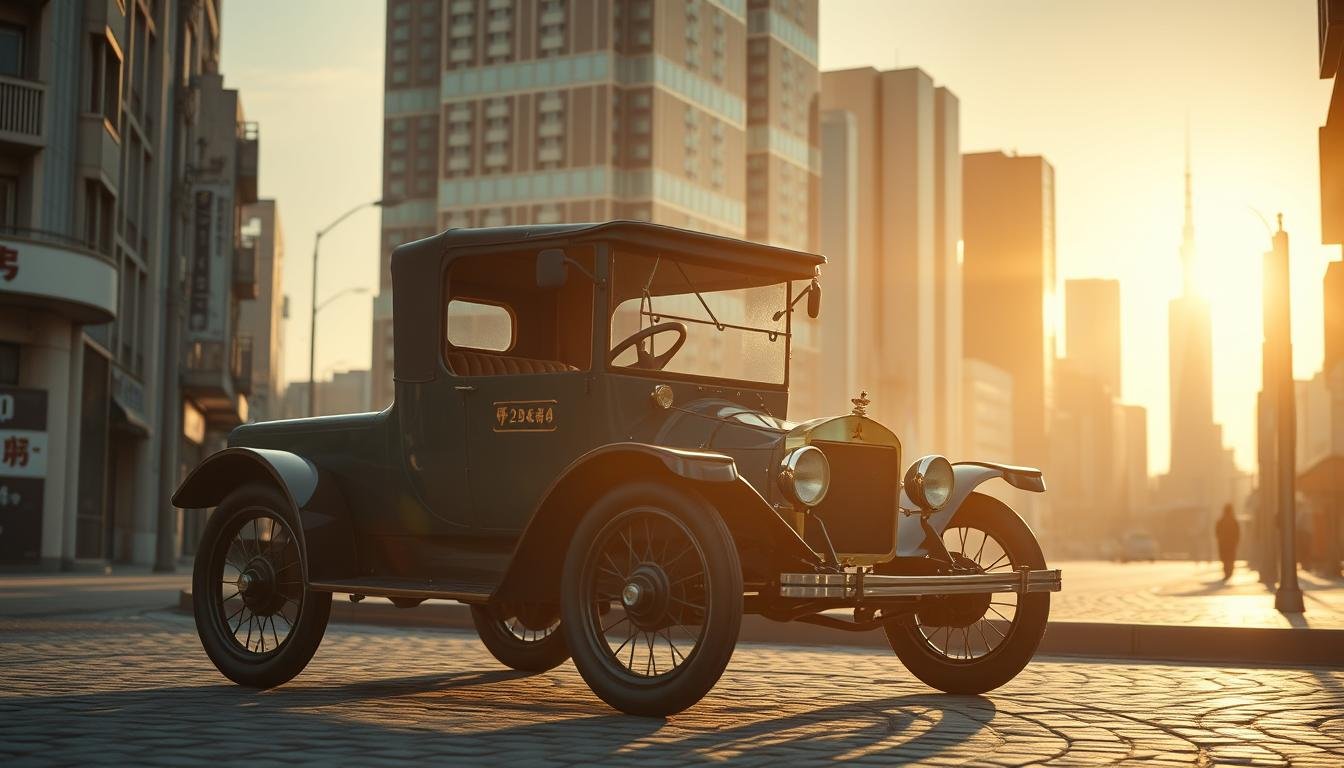

1918 Mitsubishi Model A: Japan’s First Passenger Car That Sparked a Legacy

In 1918, Mitsubishi Shipbuilding Co. introduced the 1918 Mitsubishi Model A, Japan’s first passenger car. This car combined European design from the Fiat Tipo 3 with Japanese craftsmanship. Only 22 units were made.
This car was a key part of Mitsubishi’s history and its origins. It was the first mass-produced passenger car in Japan. It showed the country’s ability to make cars.
The Model A was built entirely in Japan. It had a 2.8L four-cylinder engine and was assembled with great care. Its limited production showed the challenges but also set the stage for future cars.
This car’s legacy helped Japan prove it could compete in the global car market. It showed Japan’s ability to make cars on a large scale.
Key Takeaways
- Japan’s first passenger car, the 1918 Mitsubishi Model A, launched Mitsubishi into automotive production.
- Only 22 units were made, blending Fiat Tipo 3 design with Japanese artisanal techniques.
- It marked the mitsubishi brand birth, establishing the company’s early automotive identity.
- Its handcrafted engineering laid the groundwork for later icons like the Toyota Corolla and Prius.
- As the first japanese production passenger vehicle, it symbolized Japan’s entry into the global automotive race.
The Birth of Japanese Automotive Manufacturing
In the early 20th century, Japan’s industrial growth was fast. Japanese engineering was key to this progress. It helped early automotive japan start.
Torao Yamaha made a steam bus in 1904. Komanosuke Uchiyama followed with a gasoline car in 1907. By 1910, other companies like Kunisue and Kaishinsha Motorcar Works also started making cars. This laid the groundwork for Mitsubishi’s big step forward.

Early 20th Century Industrialization in Japan
The Meiji era brought big changes to Japan. Factories popped up everywhere. Mitsubishi Shipbuilding Co. used its shipbuilding skills to try new things.
In the 1910s, companies started working on car parts. This was a big step toward Mitsubishi’s goal of making cars.
Mitsubishi Shipbuilding Co.’s Transition to Automobiles
In 1917, Mitsubishi started working on the Model A. It was inspired by the Fiat Tipo 3. Mitsubishi innovation 1918 was clear in their work.
Workers used hammers and chisels to build car bodies. They used lacquered wood and British wool for the interior. Despite not having the right tools, they used naval precision to make cars.
The Vision Behind Japan’s First Production Car
Mitsubishi wanted to make Japan less dependent on imports. By 1921, they made 22 Model A cars. This was Japan’s first series-production passenger car.
This showed Japan’s determination to master technology. Mitsubishi became a leader in a field once dominated by Western brands. Their hard work helped Japan become a major player in the car world.
The Historical Significance of the 1918 Mitsubishi Model A
The Mitsubishi Model A is a key part of mitsubishi car history and shows Japan’s japanese auto roots. It was Japan’s first mitsubishi historical debut in passenger cars. This vintage auto japan was a big step for Japan’s industrial goals.
Even though only 22 were made, it’s remembered as the first asian automobile. Its production from 1917 to 1921 showed Japan’s move from importing to making cars. This move was a start for brands like Toyota and Honda.

Working with Fiat was a big deal for the model a historic significance. They took the Fiat Tipo 3’s design and made it their own. This showed Japan’s skill in car engineering.
These cars were made by hand with simple tools. This shows Japan’s early automotive japan skills. The car had a 2.8L engine and a 2,640 mm wheelbase. It showed Japan’s dreams and limits back then.
“The Model A was not just a car; it was a declaration of Japan’s industrial power.” — Mitsubishi Historical Archives
| Specification | Detail |
|---|---|
| Production Years | 1917–1921 |
| Total Units | 22 (including prototypes) |
| Engine Capacity | 2,765 cc I4 |
| Maximum Speed | 60 mph (97 km/h) |
The Model A was expensive and rare, but its impact is huge. It’s celebrated in Mitsubishi’s 2018 centenary and the 2022 restoration of its prototypes. This model a historical car shows how innovation starts with big challenges. It tells Japan’s story from copying to leading in cars.
From Ship to Car: Mitsubishi’s Manufacturing Evolution

Mitsubishi Shipbuilding Co. used its shipbuilding skills to make cars. This change was a big step from mitsubishi ship to car making. The 1918 Model A was the first car made this way, showing the company’s mitsubishi handcraft tradition.
Shipbuilding Expertise Applied to Automobiles
Metal work from shipyards helped in mitsubishi coach building. The Model A’s design was influenced by ship construction. The car’s parts were made with the same care as ship parts.
This mix of skills showed mitsubishi vintage engineering genius.
Challenges of New Manufacturing Techniques
Changing shipbuilding methods for cars was hard. Making smaller parts needed careful mitsubishi hand-crafted work. Engineers had to use lighter materials for cars, improving their work over 22 tries.
Each mitsubishi handmade car was made with great care. This was different from mass production.
Hand-Crafted Excellence: Artisanal Approach to Car Building
Every part of the Model A was hand-built mitsubishi by experts. Bodies were crafted with old techniques, and engines were put together with ship precision. This mitsubishi handcraft way kept quality high, even with few resources.
It started a tradition of car making as art.
Design Influences: The Fiat Tipo 3 Connection

The 1918 Mitsubishi Model A was a mix ofmitsubishi fiat tipo 3collaboration andearly japanese aesthetics. It took the Fiat Tipo 3’s chassis but made it fit Japanese craftsmanship. This mix brought togetherjapanese innovationand European car design.
Western Engineering Meets Japanese Aesthetics
Mitsubishi used the Fiat Tipo 3’s 2.8L engine but made it better for local roads.Mitsubishi design 1918focused on light materials and easy-to-use design. The car’s curves made it look unique, blendingwestern engineeringwith Japanese style.
Adaptation and Innovation in the Model A Design
Key changes were made:
- Stronger suspension for rough roads
- Used local steel to save money
- Heated interiors for cold weather
These updates showedjapanese innovation. They proved Mitsubishi could make a car that worked well in Japan.
Comparative Analysis: Model A vs. Fiat Tipo 3
Themodel a vs fiat tipo 3showed Mitsubishi’s creativity:
- Engine: Same size but made for lower-octane fuel
- Lighter by 15% thanks to aluminum
- Only 22 made, unlike Fiat’s many
Thismitsubishi fiat influencehelped Japan become a big player in cars. It mixed global ideas with local creativity.
Technical Specifications of the 1918 Mitsubishi Model A
The model a specs show a car that was way ahead of its time. At its heart was the model a engine, a 2.8L four-cylinder engine with 2,765 cc displacement. This model a engine layout made 26 kW (35 hp), enough to power a 4-door sedan that could seat seven people. The model a fuel specs included a carbureted gasoline system, common in early 20th-century cars.

| Model A Dimensions | Measurements |
|---|---|
| Wheelbase | 2,640 mm (103.9 in) |
| Overall Length | 3,830 mm (150.8 in) |
| Height | 2,070 mm (81.5 in) |
| Curb Weight | 1,315 kg (2,899 lb) |
The model a full specs showed its wooden body with a lacquered finish and British woolen interior. It had a rear-wheel drive system and live axle suspension, typical for its time. Its model a mechanical features included a manual transmission and drum brakes. Despite its size, the car could reach 60 mph (97 km/h), showing Mitsubishi’s early engineering goals.
The Handcrafted Marvel: Production Process and Craftsmanship
The 1918 Mitsubishi Model A was a blend of mitsubishi craftsmanship and early mitsubishi engineering. It was a key part of mitsubishi car legacy, combining shipbuilding skill with car innovation. The vintage car hand-built method showed great care in every detail, showing the company’s mitsubishi passion for quality.

Materials and Construction Techniques
The mitsubishi wood frame car used oak and mahogany for its body. Metal parts were made the old way, and model a build methods were inspired by shipbuilding. Without modern tools, craftsmen made sure the car was strong and lasting. Key features included:
- Wood framing like naval construction
- Hand-finished brass fittings
- Copper engine components
Interior Craftsmanship and Attention to Detail
Inside, the car showed mitsubishi vintage image with leather seats and wood panels. Every part of the dashboard was carved by skilled woodworkers. The upholstery patterns were inspired by mitsubishi craftsmanship, making each seam and rivet special.
The Team Behind the Model A’s Creation
Engineers from Mitsubishi Shipbuilding Co. brought their naval skills to car design. Led by Kotaro Honda, the team used welding and assembly from shipyards. Their work combined maritime and automotive engineering, setting the stage for Mitsubishi’s future.
Limited Production: Why Only 22 Units Were Made
The 1918 Mitsubishi Model A is a rare japanese car with only 22 units made. This mitsubishi rare model shows the challenges of the time. High costs, low demand, and a focus on aircraft engines during World War I limited its production.
Today, these model a 22 units are highly valued. They are seen as model a collectible treasures. They showcase Mitsubishi’s classic designs.
- High Production Costs: Handcrafted construction and imported parts drove up expenses.
- Market Limitations: Japan’s nascent auto market lacked buyers willing to pay premium prices.
- Strategic Shifts: Mitsubishi prioritized wartime aircraft production, diverting resources from cars.
| Vehicle | Year | Units Produced |
|---|---|---|
| Mitsubishi Model A | 1918 | 22 |
| Dodge | 1918 | 60,000+ |

Only model a 22 units exist, making the car a key part of car history. These cars are model a collectible items. They show Japan’s early engineering dreams.
Their rarity makes them very valuable. They are a mitsubishi classic showcase in museums and private collections. Historical records confirm only 22 were made, making it a rare piece of car innovation.
The Market Reality: Economic Factors and Consumer Reception

The Mitsubishi Model A faced big challenges in the model a market because of its high price. In 1918 Japan, its cost was like years of an average worker’s salary. This made it a sign of early japanese luxury only for the rich. Despite its part in mitsubishi luxury roots, its success was limited by the economy.
Pricing Challenges in 1918 Japan
- Production costs were triple those of imported cars, driven by handcrafted methods.
- Average income in Japan was too low to sustain demand, stifling mitsubishi vintage performance adoption.
- Comparison to japanese car heritage milestones like the 1970s models shows later affordability improvements.
Target Market and Accessibility
Only 22 units of the vintage car japan were made, for the wealthy. Roads and fuel networks were not well-developed, making it hard to access. A 1920s model a market analysis noted:
“The Model A’s appeal was symbolic, not practical, due to Japan’s urbanization lag.”
Public Perception of the First Japanese Production Car
| Factor | Mitsubishi Model A (1918) | Modern Cars (2023) |
|---|---|---|
| Production Volume | 22 units | Millions |
| Customer Reaction | Limited adoption but praised for mitsubishi customer reaction as a national achievement | Mass market adoption |
| Perceived Value | Symbol of japanese car heritage | Focus on efficiency |
Though mitsubishi vintage performance didn’t do well in sales, its legacy is strong. It shows how Mitsubishi went from being a niche early japanese luxury to a global brand.
The 1918 Mitsubishi Model A in Contemporary Automotive Context
In 1918, cars were changing fast. The Model A was Japan’s first car made at home. It mixed global ideas with local dreams.
Its 1918 design and 1918 car specs showed it was at the forefront of innovation.
Global Automotive Landscape of the 1910s
By the 1910s, cars were made in big numbers, like the Ford Model T. It used assembly lines to save money. European cars, like Fiat and Renault, focused on luxury.
Japan joined the game with the Model A. It was inspired by the Fiat Tipo 3. This early japanese sedan showed Mitsubishi’s global connections through Italian engineering.

How the Model A Compared to International Competitors
Looking at the Model A’s tech, we see both good and bad points. It had a 2.8L engine, like some European cars but not as cheap as the Model T.
- Engine: 2.8L four-cylinder vs. Ford’s 2.9L inline-four
- Production scale: 22 units vs. Ford’s 1 million+ annual output by 1918
- Design: 1918 design mirrored European elegance, contrasting with the Model T’s utilitarian style
Even with small numbers made, the prewar mitsubishi car helped Japan grow in cars. Its model a silhouette set a pattern for future Japanese sedans. It showed Japan’s place in the world car market.
Preservation and Legacy: Where Are the Model A Cars Today?
Out of 22 original 1918 Mitsubishi Model A cars, only three are left. These classic mitsubishi model cars are true mitsubishi collectible gems. One is in the Mitsubishi Motors Museum in Tokyo, showing off as a model a museum piece. Another is in a private collection, and the last is being mitsubishi restoration in Europe.

Many mitsubishi classic cars are at risk due to their age and the lack of parts. The Tokyo museum’s car is kept in a static display to protect it. Restorers use model a photo archives to fix the cars. A 2023 model a legacy review found one car with original paint and wood, giving historians a rare look.
| Preservation Method | Details |
|---|---|
| Digitization | 3D scans and photo archives started in 2020 |
| Corporate Programs | Mitsubishi pays for annual checks on surviving cars |
| Global Exhibits | Brief loan to London’s Science Museum in 2019 |
“The Model A’s survival challenges mirror the preservation of early automotive milestones worldwide,” said a Mitsubishi heritage curator. “Each classic mitsubishi model tells a story of Japan’s industrial awakening.”
Mitsubishi’s heritage team keeps an eye on mitsubishi collectible buyers to ensure they are genuine. The Model A is among the most valuable pre-1920 Japanese cars. Digital records help preserve its history, keeping its legacy alive as a model a museum piece and a piece of automotive history.
The Evolution of Mitsubishi Motors Following the Model A
The Model A ended in 1921, but its impact was huge. It laid the foundation for Mitsubishi’s car history. This part looks at how Mitsubishi turned early problems into key moments. These moments shaped its mitsubishi car lineage and global reach.

Lessons Learned from the First Production Model
The Model A showed the need for better manufacturing. It was expensive and made few cars. By 1970, Mitsubishi Motors Corporation was formed, using these lessons to be more efficient and competitive globally.
The 1969 creation of the Mitsubishi Motors Technical Center was a big step. It helped make mitsubishi automotive history through research and development.
How the Model A Influenced Future Designs
The Model A’s design was inspired by Italy. It showed Mitsubishi’s mix of foreign ideas and local skills. This approach was seen in later engines, like the 4G series.
The three-diamond logo, used in shipping from 1870, became a mitsubishi company origins symbol. The Model A’s design also helped create later SUVs and compact cars.
Tracing Mitsubishi’s Growth as an Automotive Manufacturer
- 1920: Nagoya Plant started making car parts after WWII.
- 1970: Mitsubishi Motors Corporation was officially started, marking a new era.
- 1971: A partnership with Chrysler helped sell cars worldwide, including in Thailand.
- 2016: Okazaki Plant, once for aircraft, became a key SUV maker, showing mitsubishi car evolution.
From 22 Model A cars to the 4G3 engine’s huge production, Mitsubishi’s story is one of overcoming obstacles. Each challenge, from early money problems to rebuilding after the war, helped it grow into a global car maker.
Cultural Impact: The Model A’s Role in Japanese Industrial Identity
The 1918 Mitsubishi Model A was more than just a car. It was a symbol of model a influence in japanese auto beginnings. Japan’s first home-made passenger car, it showed the country could make cars on its own. This was a big step for early asian automobiles.
This car’s story is about japanese industrial pride. It showed that Japanese engineers could make complex things. Today, its legacy is celebrated in museums and company archives, showing its impact on japanese innovation.
| Year | Event | Impact |
|---|---|---|
| 1918 | Model A debut | First Japanese passenger car, igniting early asian transport progress |
| 1950s–60s | Post-war industrial boom | 9% annual GDP growth fueled by automotive innovation |
| 2022 | Automotive R&D investments | 10% of Japan’s R&D spending directed toward automotive tech |

- Japan’s auto sector contributed 4% to GDP in 2022, reflecting model a vision of sustainable growth.
- Over 5 million workers are employed in Japan’s automotive industry today, echoing the Model A’s artisanal origins.
- Japan’s post-WWII automotive exports surged, establishing the mitsubishi global brand as a global leader.
The Model A’s story is part of Japan’s history. It shows the country’s move from feudalism to modernity. Its legacy is about hard work and skill, key to Japan’s japanese innovation.
Today, Mitsubishi and other global brands show how far Japan has come. The Model A’s early success paved the way for today’s automotive giants.
Technological Innovations: What Made the Model A Special
The 1918 Mitsubishi Model A was a game-changer with its advanced features. It combined imported tech with local creativity. At its heart was the model a engine, a mitsubishi 2.8l engine based on Fiat’s Tipo 3. This engine made the mitsubishi early vehicle reach a top speed of 50 km/h, a big deal back then.

The model a engine was built by hand, showing Mitsubishi’s early automotive skills. It could go up to 31 mph (50 km/h), thanks to its Italian roots and Japan’s growing engineering skills. Its reliability also paved the way for future mitsubishi 2.8l engine improvements, like the 1995 HSR-V’s GDI tech.
The model a chassis used a mix of wood and steel, making it stable on Japan’s bumpy roads. It had leaf springs for a smooth ride, setting the stage for Mitsubishi’s future model a chassis improvements. This 1918 four-door car could fit up to five people, making it a practical mitsubishi early vehicle for its time.
- Engine: 2.8L four-cylinder, 28 hp, hand-assembled
- Chassis: Wood-steel hybrid frame, leaf springs
- Comfort: Wool upholstery, enclosed cabin, side curtains
The model a comfort was all about luxury, using imported British wool cloth. Despite only making 22 units, it showed Mitsubishi’s aim to mix model a comfort with practicality. This car was a key step in Mitsubishi’s journey to becoming a global car brand.
Collector’s Perspective: The Model A as a Historic Artifact
The 1918 Mitsubishi Model A is a treasured mitsubishi vintage piece. It marks model a historic significance as Japan’s first car for passengers. With only 22 made, each car is a rare gem, showing mitsubishi heritage and early 20th-century engineering.
Today, these cars are highly sought after at auctions and mitsubishi classic showcase events globally.

Restoring a Model A requires skilled mitsubishi restoration experts. They focus on keeping the original engine parts and woodwork. Experts check engine serial numbers and production methods from 1917 to verify authenticity.
Each car’s model a historic value is high, sometimes over $5 million, because of its rarity.
| Authentication Criteria | Key Details |
|---|---|
| Engine Blocks | Stamps matching 1917 production logs |
| Bodywork | Original Japanese lacquer finishes |
| Documentation | Historical sales records from Mitsubishi Shipbuilding Co. |
The Model A is a star in the mitsubishi collectible world. Its model a historic value is as high as early European and American cars. But its unique cultural value keeps collectors eager.
Museums like the Larz Anderson Auto Museum showcase the Model A. They pair it with other cars to highlight Japan’s industrial growth.
Conclusion: How the 1918 Mitsubishi Model A Shaped Japanese Automotive History
The 1918 Mitsubishi Model A was Japan’s first passenger car. It marked the start of Mitsubishi’s journey. Only 22 units were made, but it laid the groundwork for Japan’s car industry.
This car’s success helped Japan become a major player in the auto world. In 2020, Mitsubishi produced 8.3 million vehicles. The company now focuses on making cars that are good for the planet and full of new ideas.
The Mitsubishi logo has changed over time, showing how the company has grown. From making cars by hand to using the latest technology, Mitsubishi has come a long way. The Model A’s impact is seen in the quality and design of Mitsubishi cars today.
FAQ
What was the significance of the 1918 Mitsubishi Model A?
The 1918 Mitsubishi Model A was Japan’s first mass-produced car. It marked the start of Japan’s car industry and Mitsubishi’s car-making journey.
How many units of the Mitsubishi Model A were produced?
Only 22 units of the Mitsubishi Model A were made. Today, it’s a very rare collectible.
What are the specifications of the Model A?
The Mitsubishi Model A had a 2.8L four-cylinder engine. It was handcrafted, blending Western engineering with Japanese skill.
How did the industrial climate in early 20th century Japan contribute to the Model A’s creation?
After the Meiji Restoration, Japan quickly industrialized. This led to more cars being made for the domestic market, helping create the Model A.
What technical challenges did Mitsubishi face in shifting from shipbuilding to automobile manufacturing?
Mitsubishi had to adapt shipbuilding tech to car making. They also needed to find the right materials and learn precision engineering for cars.
How did the Model A relate to the Fiat Tipo 3?
The Model A took inspiration from the Fiat Tipo 3. It mixed Western design with Japanese tastes and manufacturing needs.
What was the public reception of the Mitsubishi Model A upon its release?
The Model A was pricey and not well-known in 1918 Japan. But, it was seen as a symbol of national pride and progress.
How does the Mitsubishi Model A compare to other contemporary vehicles?
The Model A stood out with its unique design. Yet, it showed the challenges of being Japan’s first car.
What efforts are being made to preserve existing Mitsubishi Model A vehicles?
Efforts include restoring and documenting Model A cars. They’re displayed in museums, highlighting their historical and rare value.
How did the experience of the Model A influence Mitsubishi’s future automotive developments?
The Model A’s development taught Mitsubishi valuable lessons. These lessons helped shape their future success in the car industry.
What cultural impact did the Mitsubishi Model A have on Japan’s industrial identity?
The Model A showed Japan’s drive for industrial growth. It boosted national pride in manufacturing and mastering complex technologies.