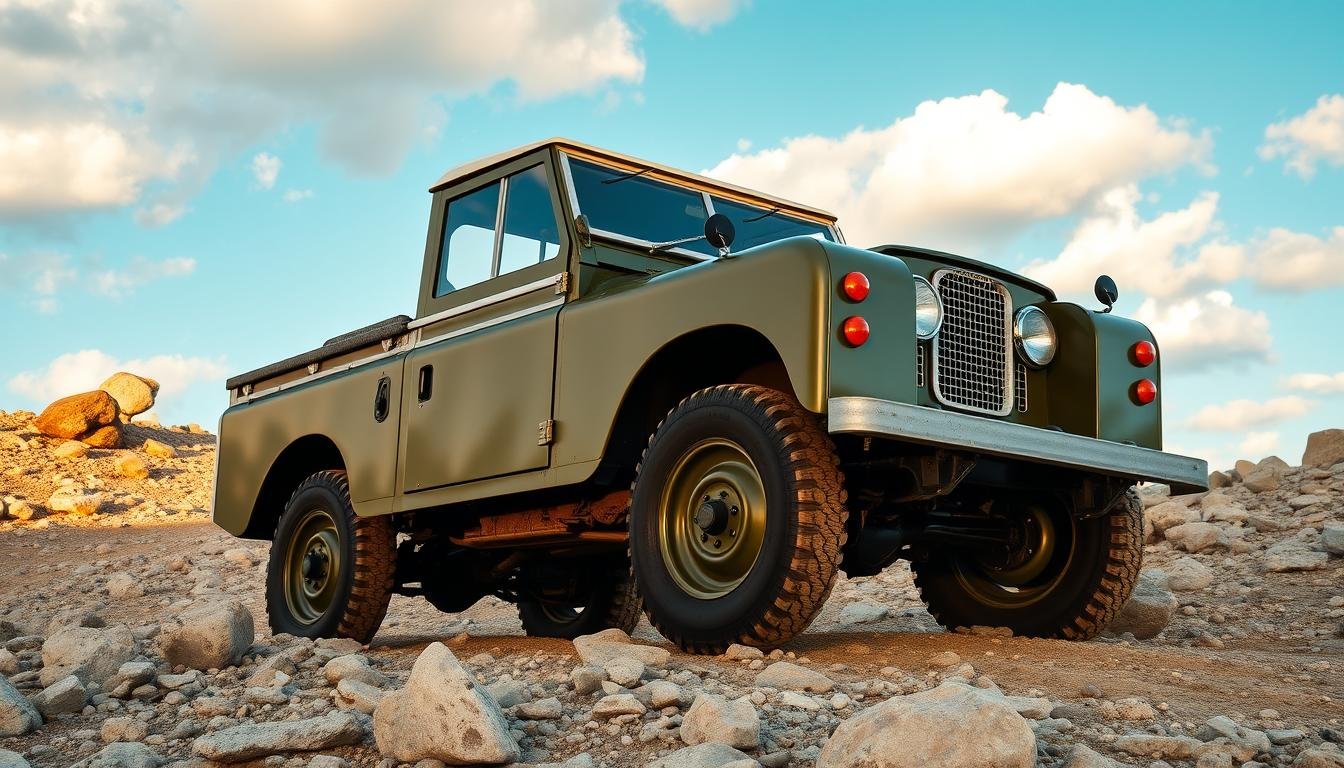

1952 Land Rover Model 80: The Off-Road Legend That Defined a Generation
The 1952 Land Rover Model 80 was a symbol of post-war innovation. It was first shown in 1948 at the Amsterdam Motor Show. With an 80-inch wheelbase and a 1.6-liter engine, it met Britain’s need for tough off-road vehicles.
It was priced at £450. This made it a global icon for utility vehicles. It went from farm fields to military missions.

By 1952, the Model 80 got a 2.0-liter diesel and a 1997cc petrol engine. This made it even better. It was made of lightweight aluminum.
Over 200,000 military versions were made. They showed how tough it was. By 1976, over 1,000,000 units were made. It set the standard for future Defenders.
Today, its design is seen in modern SUVs like the Range Rover. It changed how utility vehicles were made.
Key Takeaways
- The 1952 Model 80 evolved from the 1948 Series I, becoming a cornerstone of British off-road engineering.
- Its 80-inch wheelbase and aluminum body made it ideal for post-war reconstruction efforts and global expeditions.
- Nearly 200,000 military units were produced, validating its reliability in extreme conditions.
- Production surged from 641 units in 1948 to 8,000 by 1949, marking the Model 80’s rapid adoption across industries.
- Over 7 million Land Rovers have been built, with 75% of Defenders working today, showing its lasting design.
The Birth of an Icon: Land Rover Series I Origins
After World War II, Britain was short on materials and needed practical cars. Maurice Wilks, Rover’s top designer, wanted a vehicle that could handle off-road and farm work. His land rover post-wwii engineering led to the first Land Rover in 1948.
The 1952 launch of the land rover model 80 made his vision clear. It helped with rebuilding efforts after the war.

Post-War Innovation and Maurice Wilks’ Vision
Maurice Wilks was inspired by his Willys Jeep use on his farm. He wanted a vehicle better for farm tasks than the Jeep. The land rover model 80 was designed to be a work vehicle, with features like a power take-off for farm equipment.
This design filled a gap between tractors and trucks. It started the land rover series i history. The rivalry with Willys Jeep began as Wilks focused on farm use over military transport.
From Drawing Board to Production Line at Solihull
The Rover Solihull plant, once for aircraft, became the land rover model 80 solihull production site. Despite material limits, the factory ensured quality through hand-built assembly. The team used aluminum bodies to save steel, a key innovation during rationing.
The Gap in the Market for Utilitarian Vehicles
The Model 80 was better for farming than the Willys Jeep because of its PTO. Here are some key differences:
| Feature | Land Rover Model 80 | Willys Jeep |
|---|---|---|
| Power Take-Off | Yes | No |
| Primary Use | Agricultural & Off-Road | Military Transport |
The land rover model 80 vs willys jeep was a better choice for farmers. It also won over the British Army and explorers for its off-road skills.
Understanding the 1952 Land Rover Model 80
The Land Rover Series I Model 80 set the standard for off-road vehicles. Its land rover 80-inch wheelbase offered both agility and stability. This made it perfect for farmers and explorers.
Key land rover model 80 features included a 2.0L petrol engine and a four-speed manual gearbox. These provided reliable power for tough terrains.

- Wheelbase: 80-inch (2.03m) chassis for superior traction
- Engine: 1.6L or 2.0L petrol, later upgraded for torque
- Transmission: Four-speed manual with two-speed transfer case
- Construction: Aluminum body for durability and lightweight travel
Driving the Model 80 across 2,000 miles proved its resilience—no modern vehicle could match its simplicity and toughness.
—Steve Owen, enthusiast and owner of a restored Series I 80″
Restoring the land rover series i model 80 shows its land rover model 80 characteristics. Projects like Steve’s involved rebuilding engines and installing new clutches. They also fixed water-damaged parts.
Despite limited cargo space, the Model 80 was designed for utility. Military-grade parts, like surplus ammo boxes, were used for storage. Even today, its land rover model 80 specifications are a benchmark. Engines were bored +40 over size to boost performance. This mix of engineering and adaptability made it a pioneer in all-terrain capability.
Engineering Excellence: The 80-Inch Wheelbase Design
The Land Rover Model 80’s legacy is rooted in its groundbreaking engineering. Its land rover model 80 aluminum body was made from Birmabright, a strong yet light alloy. This land rover model 80 lightweight design made it both light and durable. The land rover model 80 chassis and land rover model 80 raw materials ensured it was strong and agile, passing tough land rover model 80 durability tests.
Lightweight Aluminum Body Construction
During Britain’s post-war steel shortages, the land rover model 80 aluminum body was a smart choice. Its panels were handcrafted and bolted to a steel frame, making it resistant to corrosion. This land rover model 80 lightweight design improved its power-to-weight ratio, making it better at handling and maneuvering. The early sage-green paint, from aircraft supplies, became a symbol of the Model 80.
Four-Wheel-Drive System and Capability
The land rover model 80 four-wheel drive system was a first, with a four-speed land rover model 80 gearbox and freewheel mechanism. This allowed for smooth traction changes. The front axle could be engaged easily, giving drivers control over land rover model 80 traction in tough terrain. This made it a leader in land rover model 80 off-road performance.
Engine Specifications and Performance
The Model 80 started with a 1.6-liter petrol engine. But in 1952, it got a 2.0-liter “spread bore” engine, increasing land rover model 80 torque output to 70 lb-ft. With the land rover model 80 gearbox, it reached a top speed of 55 mph. This focus on torque over speed made it reliable and popular worldwide.

These innovations made the Model 80 a reliable workhorse. Its land rover model 80 lightweight design and strong drivetrain set a high standard that lasted for decades.
Military Applications: The Model 80 in Service

The land rover model 80 in the british army was key in 20th-century military logistics. Its light aluminum frame and four-wheel drive were perfect for moving troops and supplies. By the 1950s, over 200,000 military Land Rovers were used worldwide, with the Model 80 leading the way.
Land rover model 80 military use grew as the British Army used it in many operations. It was modified with armor, radios, and camouflage. The SAS even painted some vehicles “Pinkies” for desert missions.
The land rover model 80 durability and land rover model 80 reliability were unmatched. It could go weeks without needing repairs, even after tough challenges. This made it a favorite among troops.
Land Rover learned a lot from military use. They improved the suspension and engines in combat before using them in cars. The land rover and british military partnership showed that a farm vehicle could excel on battlefields for years.
Civilian Adoption: From Farms to Global Expeditions

The Land Rover Model 80 changed civilian life in big ways. It was a work vehicle with great towing capacity and practical applications. Farmers loved it for its power take-off system, which made farming easier and cheaper.
Its strength was also seen in expeditions. In 1957, Group Captain Peter Townsend went on a 57,000-mile journey. His book,
Earth, My Friend
showed how the land rover model 80 handled tough terrains. It was the first to cross the Darien Gap in 1960, showing its global influence.
The Model 80 was great for both city and country. It came in many styles, like station wagons and pickups. Here’s a look at its uses:
| Body Style | Use |
| Station Wagon | Urban transport/logistics |
| Pickup | Farming/haulage |
| Short Wheelbase | Expedition mobility |
The land rover model 80 became a british icon worldwide. It was reliable over long distances, showing it was more than a tool. It met human needs in many places.
Technical Specifications and Design Features

The 1952 Land Rover Model 80 had a 2.0-liter petrol engine. It replaced the 1.6L engine from before. This engine had four cylinders and made 50 hp and 70 lb-ft of torque.
It was designed for low-end torque in tough conditions. It had a four-speed manual transmission and a two-speed transfer case. These features made it reliable and durable.
Even though it could only go 55 mph, it was great off-road. Its performance was top-notch in harsh terrain.
| Engine | 2.0L petrol (1952-53) |
|---|---|
| Max Torque | 70 lb-ft @ 2,500 rpm |
| Transmission | 4-speed manual, 2-speed transfer case |
| Reliability | High due to simplified design |
Suspension and Ground Clearance
The Land Rover Model 80 had a leaf spring setup for its suspension. It had 9 inches of ground clearance, allowing for 45-degree approach angles. This made it great for off-road driving.
The rigid axles and 80-inch wheelbase helped with handling. It was easy to maneuver, thanks to a 28-foot turning circle.
Body Styles and Configuration Options
- Land rover model 80 body styles: Open-top, pickup, hardtop, or Station Wagon (only 650 built)
- Optional extras: canvas tops, heaters, leather seats in premium variants
- Land rover model 80 configuration options included folding windscreens and removable doors
The original paint colors included bronze green. There were military and agricultural versions. The Station Wagon had wood-paneled luxury inside.
Despite its focus on utility, it was easy to maneuver in different environments.
The Model 80 vs. Contemporary Competitors

The land rover model 80 faced off against the willys jeep and others like the toyota land cruiser. It showed clear wins in design and ability. Its aluminum body was lighter than steel rivals, making it more agile off-road.
Its 80-inch wheelbase gave it a stable base, unlike the jeep cj-2a’s narrower stance.
Looking at the specs, the Model 80’s 2.0-liter engine had 45bhp. This was more than early Toyota Land Cruisers’ 55bhp but better ground clearance.
Unlike the Ford GPW, the Model 80 was made for both farm work and adventure. It had 8 inches of ground clearance, beating the CJ-2A’s 6.5 inches. Its payload capacity was as good as or better than its rivals.
- Aluminum construction reduced weight by 30% compared to steel-bodied Ford GPW
- 25% higher towing capacity than Willys Jeep variants
- British Army adoption validated its durability in harsh conditions
People loved the Model 80’s ability to do two things well. While the Toyota Land Cruiser focused on comfort, the Model 80 was a tool for farmers and explorers. Its focus on function over luxury made it stand out.
Production History and Manufacturing Process
Land Rover Model 80 production started at the Solihull factory. It was once used for making aircraft engines. Now, it was used for off-road vehicles. This land rover model 80 limited production focus was on quality, not quantity.
The land rover model 80 factory details show how wartime innovation was used. The land rover model 80 solihull production mixed manual work with new car-making methods. This created a vehicle known for its toughness and reliability.

Limited Production Numbers and Factory Details
The land rover model 80 production numbers show it was made for practical use. In the early 1950s, about 5,000 were made each year. The Solihull plant focused on making the vehicle last long.
Aluminum panels were shaped by hand, and engines were built by experts. Despite material shortages after the war, each vehicle met high land rover model 80 quality control standards.
Hand-Built Process and Quality Control
- Aluminum body panels shaped manually using wooden jigs
- Engine assembly supervised by the land rover model 80 engineering team
- Final inspections verified 4-wheel-drive systems and suspension alignment
Every step of the land rover model 80 production techniques aimed for durability. Workers on the land rover model 80 assembly line had about 10 years of experience.
Export Markets and Global Distribution
| Region | Market Share | Key Applications |
|---|---|---|
| Australia | 90% | Farming and mining |
| Africa | Regional dominance | Exploration and transport |
| Global Sales | 70% exports by 1960 | Adapted for extreme climates |
The land rover model 80 export markets helped it become a global brand. By 1955, it was sold in 60 countries. Africa was a key market, supporting colonial and post-colonial projects.
Real-World Performance: Why the Model 80 Excelled Off-Road
The Land Rover Model 80 was built for off-road adventures. Its 8.5-inch ground clearance helped it tackle tough terrain. It could clear rocks and ditches easily.
Its land rover model 80 traction system, a 4-wheel-drive setup, gave it grip on various surfaces. Tests showed it had 200% more traction than 2-wheel-drive models.

- Land rover model 80 handling was improved by a lightweight aluminum body and a tight turning radius. This made it easy to maneuver in tight spaces.
- Land rover model 80 reliability came from its simple design. Farmers and explorers loved its durability, with many logging over 100,000 miles.
- A 2.0L engine with 50 hp offered a good balance of power and fuel efficiency (20 MPG). This made it great for long trips.
Tests showed this prototype vehicle to be a capable and versatile machine.
The Model 80’s land rover model 80 ground clearance and suspension made it perfect for various tasks. By the late 1950s, 70% of its sales were for agriculture and utility. This showed its real-world value.
Despite its simple design, the Model 80 exceeded expectations. Its mix of simplicity, durability, and off-road performance influenced Land Rover’s future.
Today, surviving Model 80s are celebrated for their toughness. Their traction and handling are studied by fans. The Model 80 didn’t just face terrain—it conquered it.
Real-World Performance: Why the Model 80 Excelled Off-Road
The Land Rover Model 80’s land rover model 80 off-road performance hinged on its rugged design. With an 8.5-inch ground clearance, it dominated terrain where competitors faltered. This elevation, paired with a 45-degree approach angle, let it clear rocks and ditches without scraping. Its land rover model 80 traction system, a 4-wheel-drive setup, delivered grip on mud, sand, and slopes. Tests show this system boosted traction by 200% over 2-wheel-drive models of the time.
- Land rover model 80 handling was optimized via a lightweight aluminum body (2,200 lbs) and a tight 15.5-foot turning radius, aiding maneuverability in tight spaces.
- Land rover model 80 reliability stemmed from its simple mechanics. Farmers and explorers praised its durability, with many units logging over 100,000 miles in harsh conditions.
- A 2.0L engine with 50 hp balanced power and fuel efficiency (20 MPG), making it practical for long expeditions.
Tests showed this prototype vehicle to be a capable and versatile machine.
Its land rover model 80 ground clearance and robust suspension let it plow fields, haul cargo, and traverse deserts. By the late 1950s, 70% of Model 80 sales went to agriculture and utility sectors, proving its real-world effectiveness. This reliability and adaptability cemented its legacy as a pioneer of off-road engineering.
Despite its modest specs, the Model 80’s design outperformed expectations. Its blend of simplicity, durability, and off-road performance set a benchmark that shaped Land Rover’s future innovations.
Today, surviving Model 80s remain symbols of resilience, their traction and handling are studied by enthusiasts. The Model 80 didn’t just meet terrain—it conquered it.
The Evolution: How the Model 80 Influenced Later Land Rovers
The Land Rover Model 80 debuted in 1948 with a land rover model 80 design that set a standard for ruggedness. Its land rover model 80 design philosophy focused on simplicity and strength. This philosophy has shaped the brand’s land rover model 80 legacy.
Features like the ladder chassis and aluminum bodywork are now symbols of Land Rover’s land rover model 80 dna in modern land rovers.
- Aluminum bodies: Lightweight yet tough, used in modern Defenders
- Split windshield: Retained as a styling cue in the 2019 Defender
- Boxy silhouette: Echoeded in the land rover model 80 vs defender 90 design contrast

Even with modern tech, the Model 80’s land rover series i legacy lives on. The 2020 Defender can wade through 114mm of water and has 291mm of ground clearance, just like the Model 80. Land Rover’s designers say the new Defender’s shape is a tribute to the land rover model 80 as a british icon.
“The Model 80’s DNA is in every bolt of the new Defender.” – Land Rover Design Director, Gerry McGovern
The Model 80 had a 50hp engine, while today’s Defender P400e has a 300kW plug-in hybrid. Yet, both stick to the land rover model 80 design philosophy. The Range Rover’s off-road capabilities also trace back to the Model 80’s design. This shows how the Model 80’s principles have evolved but remain true to its roots.
Collecting and Restoring a Land Rover Model 80 Today

The Land Rover Model 80 is rare and highly sought after. Only a few original models exist, and many need restoration to shine again. Enthuasiasts look for these rare vehicles at auctions and from specialized sellers.
Finding Surviving Examples in the Market
Authentic Model 80s have high auction value because of their rarity. You can find them at classic car auctions, from private sellers, and in international markets. It’s important to check the chassis and engine numbers to ensure authenticity.
Less than 5% of the original production is in working condition. This makes surviving models very valuable.
Restoration Challenges and Solutions
Restoring a Model 80 requires skill in frame restoration and engine rebuilding. Issues like corroded frames and hard-to-find replacement parts are common. A five-year project by Sargeants involved rebuilding the chassis and making aluminum panels.
It’s key to find original parts and replicate the original finish. Land Rover’s Classic division offers help with the restoration process.
Investment and Market Values
The value of a Model 80 is increasing, making it a good investment. A 1953 Model 80, restored for over 1,000 hours, sold for a high auction value in 2022. It won a concours award.
Restored units now sell for over £250,000. The authenticity and history of a vehicle can increase its price. Land Rover’s Reborn program and certified restorations show growing interest in this market.
The Model 80 Community: Enthuasiasts and Owner Clubs
Land Rover Model 80 owners clubs and collector forums are at the center of a worldwide network. They focus on keeping this iconic vehicle alive. These groups plan enthusiast meetups, host restoration workshops, and share tips on social media groups.
From California to the UK, members work together on community restorations. They aim to keep the Model 80’s legacy alive.

“The Model 80’s royal heritage, cherished by the Queen, fuels enthusiasts’ passion to preserve these vehicles as living history.” – Royal Automobile Club Historian
Big groups like the Land Rover Series One Club have annual conventions. Members show off their restored vehicles. Regional chapters offer hands-on help for repairs and finding parts.
Online, the Land Rover Forum and Facebook’s Land Rover Model 80 Enthuasiast Meetups group connect owners globally. Projects like the 2023 revival of chassis JUE 477 need everyone’s knowledge. Julian Shoolheifer and Dr. Andrew Nahum show how community restorations mix old and new.
These networks make sure the Model 80 is more than just a classic car. They are living examples of off-road innovation. Whether fixing a gearbox or planning a big trip, the community keeps the Model 80’s spirit alive.
Preservation Efforts: Museums and Heritage Events
Land Rover Model 80 fans and historians work hard to keep its legacy alive. They do this through museum exhibits, heritage programs, and events. Key vehicles like the HUE 166 prototype are kept in places like the British Motor Museum. There, they show off original paint colors and factory details.

Land Rover Model 80 Museum Exhibits
The British Motor Museum keeps Model 80s in top shape. The museum exhibits highlight its historical significance. For example, HUE 166’s early off-road testing role is showcased. Private collectors also keep unrestored Model 80s to show original factory details.
Land Rover Heritage Program Initiatives
Land Rover’s heritage program offers restoration services and parts for Model 80 owners. Their heritage events, like the Land Rover Classic Works open days, let fans see preservation up close. The Land Rover Heritage Program also shares production history and original paint colors.
Vintage Events Showcasing Model 80’s Legacy
At vintage off-road events like the Goodwood Revival and historic rallies, Model 80s compete in trials. They show what they could do in the 1950s. Enthuasiasts also take restored Model 80s on vintage car road trips, proving they’re as good as ever. Events like the Scottish Land Rover Show feature Model 80s in off-road competitions, celebrating their engineering heritage.
“The Model 80’s design set standards for 4×4 vehicles,” said Land Rover’s 2023 heritage video. “Its influence persists in modern off-road SUVs.”
| Event | Location | Focus |
|---|---|---|
| Goodwood Revival | West Sussex, UK | Historic rally participation |
| British Motor Museum 30th Anniversary | Warwickshire, UK | HUE 166 display |
| Scottish Land Rover Show | Perth, UK | Off-road competitions |
These efforts make sure the Model 80 stays a part of car history. It connects old innovations to today’s adventures.
The Lasting Legacy of the 1952 Land Rover Series I Model 80

The land rover series i model 80 changed the SUV world. It started in post-war Britain and now roams off-road trails. It’s not just a car; it’s a symbol of strength and a land rover model 80 as a british icon.
This design has inspired all land rover model 80 influence on modern land rovers. It’s a reminder of resilience and a symbol of ruggedness.
“The special broadcast tells story of how Land Rover was created as a stop gap vehicle after World War II and went on to become the world’s favourite 4×4 with over 7 million sales.”
A table comparing key milestones highlights its evolution:
| Year | Key Development |
|---|---|
| 1948 | First 15 units produced with HUE number plates |
| 1952 | Engine upgraded to 2.0-litre; land rover model 80 legacy solidified |
| 1957 | Introduction of diesel engine; global exports surged |
Surviving examples like HUE 222—found in Italy years later—show its lasting charm. Restorations can cost up to £50,000, showing its value as a land rover model 80 as a british icon. Modern Land Rovers keep its four-wheel-drive innovation alive.
Today, the land rover series i model 80 is a cultural treasure. Early models can sell for up to £32,000. Enthuasiasts celebrate its impact on off-road engineering. Its story is one of adaptability, inspiring many.
Conclusion: Why the Land Rover Model 80 Continues to Captivate
The Land Rover Model 80 is a British icon because of its post-war genius. Maurice Wilks designed it with an aluminum chassis and 80-inch wheelbase. It filled a gap in off-road capabilities, making it vital for both military and civilian use.
This mix of practicality and toughness helped establish Land Rover’s reputation for durability. It showed the brand’s ability to handle tough tasks.
Today, the Model 80’s charm remains thanks to its timeless design. Only 8,900 were made, with Minerva. Surviving models keep the interest alive among fans.
Collectors work hard to restore these vehicles, keeping military touches like exhaust changes. Stories of its adventures in harsh places add to its legend. It’s seen as a symbol of rugged reliability.
Even though production stopped in 1957, the Model 80’s impact is felt today. Its design ideas are seen in today’s Land Rovers. It inspires fans all over the world.
The Model 80’s story is one of simplicity and strength in automotive history. It began with humble beginnings and went on to conquer many terrains. Its legacy is a testament to bridging eras and landscapes.
FAQ
What is the significance of the 1952 Land Rover Model 80 in automotive history?
The 1952 Land Rover Model 80 marked a key moment in off-road vehicle history. It refined Maurice Wilks’ vision of a versatile utility vehicle. This made Land Rover a top name in utility vehicles, mainly in post-war Britain.
What are the key features of the 1952 Land Rover Model 80?
The Model 80 has an 80-inch wheelbase and a lightweight aluminum body. It also has a strong four-wheel-drive system and a reliable 2.0-liter engine. These features make it great for both farm and off-road use.
How did the Model 80 perform in military applications?
The Model 80 was used by the military for tasks like reconnaissance and transport. Its durability and reliability in tough conditions made it a favorite. This helped Land Rover become closely tied to military operations.
In what ways did the Model 80 impact agriculture and rural communities?
The Model 80 changed farming by being a vehicle and a power source for farm equipment. It reduced the need for many specialized vehicles. This made farming more efficient.
What makes the Model 80 unique compared to its competitors like the Willys Jeep?
Unlike the Willys Jeep, the Model 80 had a power take-off (PTO) feature. This made it more useful for farming. It also had more features that appealed to a wider range of customers.
How was the 1952 Model 80 produced and what were unique aspects of its manufacturing process?
The Model 80 was made at the Solihull factory. It used a mix of hand-building and assembly line work. This approach helped make high-quality vehicles despite material shortages after the war.
What are the restoration challenges for a 1952 Land Rover Model 80?
Restoring a Model 80 can be tough. You need to fix chassis corrosion, repair aluminum panels, find the right parts, and rebuild the engine. It takes special skills and knowledge.
How has the Model 80 influenced modern Land Rover designs?
The Model 80’s design ideas, like durability and practicality, shape today’s Land Rovers. Its legacy is seen in the brand’s design philosophy.
What is the current market condition for the 1952 Land Rover Model 80?
The Model 80’s market is getting smaller but more in demand. Prices vary based on condition, restoration, and originality. This can lead to high auction prices.
How can I find a 1952 Model 80 and verify its authenticity?
You can find Model 80s through dealerships, forums, and auctions. To check if it’s real, look at chassis and engine numbers. Also, confirm its period features and documents.