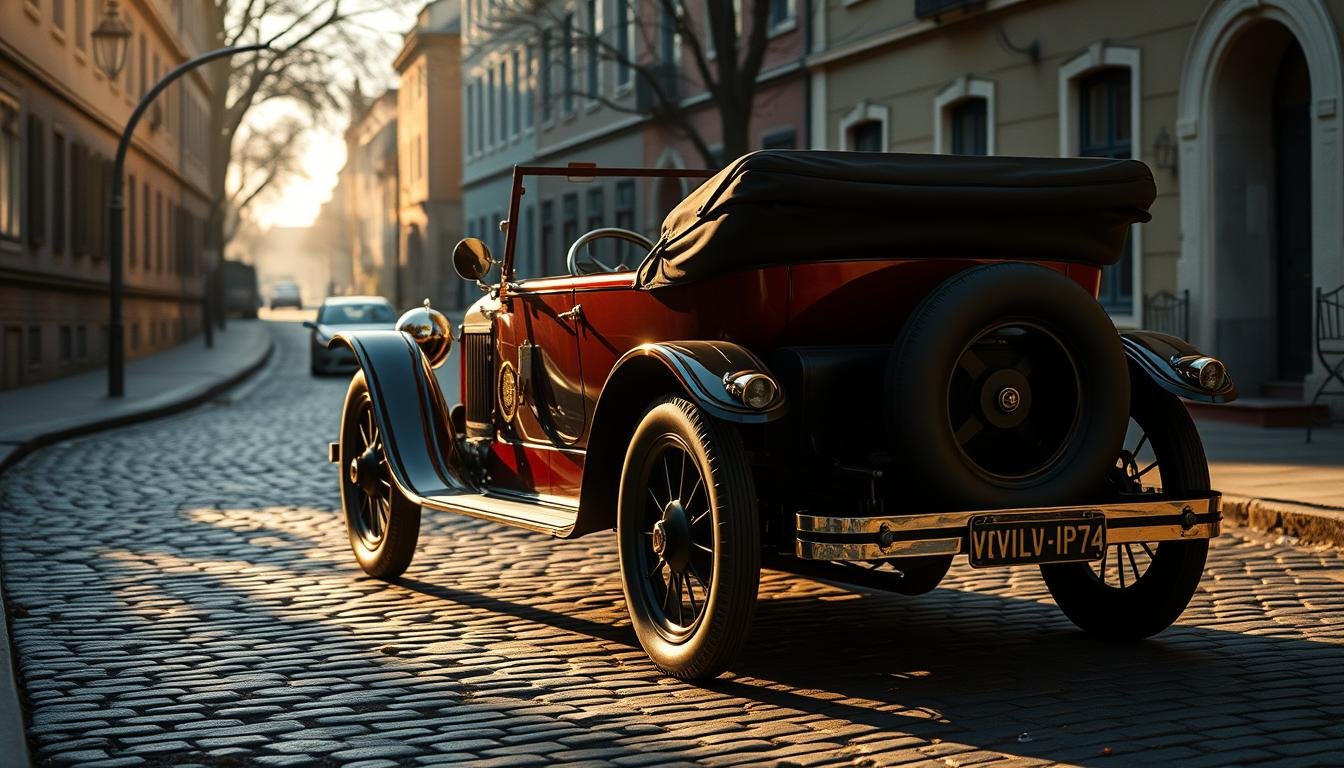

1926 Volvo ÖV4: The Open-Top Legend That Started It All
The 1926 Volvo ÖV4, also called the “Jakob,” marked Volvo’s entry into car history. It was the first Swedish car to bear the Volvo name. Born in Gothenburg, Sweden, this open-top model laid the groundwork for Volvo’s reputation for practicality and durability.
Launched in 1927, the ÖV4 showed early Swedish engineering values. It set a standard for safety and reliability that Volvo is known for today.
The ÖV4 was Volvo’s first car, starting from simple beginnings. Volvo was founded in 1927 by Assar Gabrielsson and Gustaf Larson. They began with just ten prototypes in 1926.
The open-top ÖV4, made in 996 units, marked the beginning of Volvo’s journey. It led to important milestones like the three-point seatbelt and the iconic Volvo 240. Its nickname “Jakob” honored its straightforward engineering, showing the 1920s Volvo car spirit of simple yet strong design.

Key Takeaways
- The 1926 Volvo ÖV4 (Jakob) was Sweden’s first mass-produced car, launched in 1927.
- Volvo’s founding in 1927 set the stage for automotive innovations like the three-point seatbelt and the Volvo 240 series.
- The ÖV4’s open-top design and 1.9-liter engine made it a practical choice for Sweden’s rugged terrain.
- Only 996 ÖV4 units were made, making it rare in Volvo OV4 history.
- Its legacy influenced decades of Volvo’s safety-first philosophy and durability standards.
The Birth of a Swedish Automotive Icon
In 1924, at Stockholm’s Sturehof Restaurant, accountant Assar Gabrielsson and engineer Gustaf Larson started a dream. They wanted to make cars from Swedish steel for Sweden’s tough terrain. Their Volvo founder vision led to the creation of Volvo classic models like the ÖV4. Launched in 1927, it showed Volvo’s commitment to durability and quality.

Founding Vision Behind Volvo
Volvo was born from Gabrielsson’s business skills and Larson’s engineering. They got support from SKF to use local materials. This made their cars reliable for Sweden’s cold winters.
Their focus on quality over quantity shaped Volvo’s engineering. The first Volvo öv4 facts, like its 28-horsepower engine, showed their dedication to practicality and toughness.
The Significance of the Name “ÖV4”
The Volvo öv4 meaning is simple: “Öppen Vagn 4 cylindrar” (Open Carriage 4 cylinders). It highlights its design and engine. The name shows Volvo’s focus on function over style, a trait in its Volvo classic models.
Why “Jakob” Became Its Affectionate Nickname
In 1926, a prototype was named Jakob car Volvo. It was named after Volvo öv4 jakobs, St. James’s Day (July 25). This name honored the founders’ meeting date and their goal to create a Swedish automotive icon.
Historical Context: Sweden’s Automotive Landscape in the 1920s
In the 1920s, Sweden’s roads were filled with American cars from Ford and GM. These brands were so common that Sweden didn’t have its own car icon until Volvo came along. The harsh weather and rough terrain made these cars unreliable, leading to a need for stronger vehicles.

Volvo started with just 10 OV4 prototypes before making more cars. By 1927, they had made 280 OV4s. After World War I, Sweden’s economy grew, and people wanted cars made in Sweden. This was also a time of national pride in Swedish cars.
- 1920s Swedish auto industry: 90% of cars were imported
- Volvo’s solution: The OV4’s 1.9L engine and sturdy chassis met Sweden’s demands
- Production milestone: 996 total OV4 units built by 1929
| Specification | Volvo ÖV4 Details |
|---|---|
| Engine | 1.9L inline-4, 28bhp |
| Production Period | April 1927–April 1929 |
| Price (OV4) | 4,800 SEK |
| Key Design Focus | Rugged durability for Swedish conditions |
Volvo changed the Swedish car industry by focusing on practicality. The OV4’s success showed Sweden could make cars that were reliable and strong. This was the start of Volvo’s reputation for making cars that could handle tough conditions.
The Launch That Made History: April 14, 1927
Volvo’s journey started with the Volvo 1926 launch. It reached a milestone with the Volvo ÖV4 launch on April 14, 1927. This Volvo OV4 production marked Sweden’s start in the automotive world. The first Volvo 1926 vehicle was made months before the official Volvo OV4 production year.

The First Production Run in 1926
Volvo OV4 production secretly started in 1926. Engineers worked hard to perfect the Volvo OV4 timeline. That year, they made 205 units, testing them in Sweden’s tough winters.
These early cars set the stage for 280 cars by 1928. They showed Volvo’s dedication to making durable vehicles.
The Official Unveiling Ceremony
Gustaf Larson’s joke about the bridle on the horse’s rear end turned a mechanical flaw into a story of resilience.
At the April 14, 1927, event, the Volvo OV4 unveiling had a surprise. The first Volvo 1926 vehicle’s gearbox was reversed. But Larson’s quick wit made everyone laugh, showing Volvo’s human side.
People were amazed by the ÖV4’s 28-horsepower engine and strong frame.
Initial Public Reception
Early reviews praised the Volvo OV4 early review’s reliability. Swedish buyers loved its strength, unlike flimsier imports. By 1930, 639 cars were sold, showing strong demand.
This success helped Volvo grow, with trucks becoming a key part by the late 1920s.
| Year | Event |
|---|---|
| 1926 | First OV4 prototype production begins |
| April 14, 1927 | Official launch of the ÖV4 “Jakob” |
| 1928 | 280 cars produced, 1,000 trucks sold |
| 1930 | 639 cars sold, financial stability achieved |
Engineering Marvel: The 1926 Volvo ÖV4 Up Close
The Volvo ÖV4 was a mix of practicality and innovation. Its Volvo ov4 chassis and Volvo ov4 design were built for Sweden’s tough terrain. The Volvo ov4 frame used ash and beech wood, making it light yet strong.
The Volvo ov4 bodywork was designed to be both durable and simple. This was key for reliability on rough roads.
Chassis and Body Design
The Volvo ov4 chassis mixed wood and steel for strength and lightness. Its 2.7-meter wheelbase and 4.3-meter length were perfect for comfort and cargo. The Volvo ov4 bodywork used pressed steel, a modern choice at the time, to fight corrosion.
The 1.9-Liter Four-Cylinder Powerplant
The heart of the Volvo ÖV4 was its Volvo 1.9l engine. This 1,872cc four-cylinder engine ran at 2,000 RPM, producing 28 horsepower. Its design allowed it to run on Sweden’s low-octane fuels, ensuring it was reliable.
The Volvo ov4 engine layout placed the motor longitudinally. This affected cooling and weight distribution.
Transmission and Driving Mechanics
The Volvo ov4 transmission had a three-speed manual with reverse. Later, a two-speed “overdrive” was added for better highway performance. The Volvo ov4 suspension used semi-elliptical leaf springs to smooth out bumps.
Steering was via a worm-and-wheel system, a common but effective choice for its time.
| Spec | Details |
|---|---|
| Engine | Volvo 1.9l engine (28 hp) |
| Transmission | 3-speed manual with reverse |
| Weight | 1,200 kg (2,646 lbs) |
| Top Speed | 55 mph (90 km/h) |

Designed for Swedish Conditions: Practical Innovations
The 1926 Volvo ÖV4 was made to excel in Volvo Swedish conditions. As an Volvo open vehicle, it had a strong Volvo ov4 structure

| Feature | Engineering Solution |
|---|---|
| Wheels | Spoked Volvo ov4 wheels gave good grip on snow and gravel |
| Doors | Stainless-steel Volvo ov4 doors fought off corrosion from road salt |
| Build quality | A Volvo ov4 custom build method used heat-treated steel for extra strength |
Even though it was an open vehicle, it had a special door latch for safety. The Volvo ov4 build quality focused on Volvo Swedish conditions. It had thermal insulation and paint that resisted salt.
Engineers made the Volvo ov4 structure strong to handle crashes, years before safety rules were made. This focus on practicality helped start Volvo’s reputation for Volvo ov4 durability and smart engineering.
Performance and Capabilities: What Made the ÖV4 Special
The 1926 Volvo ÖV4 was known for its Volvo ov4 performance. It had a 1.9-liter four-cylinder engine that produced 28 horsepower. This engine allowed the car to reach a top speed of about 50 mph.
This speed was perfect for Swedish roads. The car was designed for steady progress, not just speed.

28 Horsepower: Impressive for Its Era
The Volvo ov4 engine specs were impressive for 1926. It had a carbureted Volvo ov4 fuel system. This system worked well with the fuel available in Sweden.
This setup ensured the car performed well, even with lower-quality fuels. This was important for rural areas.
Handling and Road Behavior
The ÖV4 was known for its stable handling. It had leaf-spring suspension and balanced weight distribution. This made it predictable on unpaved roads.
Drivers found it felt planted even when speeding. Its Volvo vintage specs made it reliable on bumpy terrain.
Fuel Efficiency and Range
Despite its engine, the car could go 200 miles on a tank. Its Volvo ov4 fuel system worked well with Sweden’s fuel options. This avoided tax issues faced by British models.
This flexibility made it a great choice for farmers and tradespeople.
| Category | Details |
|---|---|
| Engine | 1.9L four-cylinder, 28 hp |
| Top Speed | ~50 mph |
| Range | 200 miles per tank |
| Fuel | Gasoline (flexible fuel quality tolerance) |
| Weight | 1,600 kg (3,527 lbs) |
The Volvo vintage specs showed Volvo’s focus on practical engineering. The ÖV4’s power, handling, and fuel adaptability made it a durable choice for early 20th-century Scandin.
Inside the Jakob: Interior Features and Driver Experience

The Volvo ÖV4’s cockpit was a symbol of 1920s practicality. Its interior had a simple dashboard with key gauges and wood trim. The seats were made for four people and used tough fabric to handle Sweden’s cold.
Controls like the Volvo ov4 steering wheel and manual gearshift focused on function. This design reflected the era’s engineering values.
Being an open-top model, the Volvo vintage interior was all about usability. Drivers used simple gauges in the center and sat close to the road for better control. Early owners loved the comfort, despite basic suspension, saying the interior helped them focus on driving.
Materials like leatherette and strong frames showed the car’s durability. Driving without a roof was a challenge, but it made the experience rewarding. This mix of practicality and innovation helped shape Volvo’s future focus on safety.
Production Numbers and Rarity Factor
The Volvo ÖV4 is a rare gem for collectors. Only 996 were made, and today, less than 50 remain. This makes each one a piece of history. For fans, knowing how rare it is helps explain its high value at auctions.

Why Only 996 Units Were Manufactured
Volvo’s first batch was limited. The first 275 units were split between convertibles and pickup trucks. But, economic issues and the launch of the 1928 PV4 stopped production at 996.
As a new brand, Volvo chose quality over quantity. This decision ensured the ÖV4’s rarity but also fixed its production number in history.
Surviving Models Today
Today, less than 50 ÖV4s are left, mostly in Sweden. War and years of neglect destroyed many. Now, museums and collectors protect the few that remain.
The Volvo Museum in Gothenburg and private collectors keep these cars safe. Their rarity makes each one a unique find.
Current Valuation and Collectible Status
At auctions, ÖV4s are among the most sought-after classic Volvos. In 2023, two models sold for £129,625 and £153,299. This shows their value to collectors.
Auction records and collector groups like RM Sotheby’s track their worth. Perfect examples can sell for over $100,000. This makes the ÖV4 a big investment for serious collectors.
The ÖV4’s Influence on Volvo’s Design Language
The Volvo ÖV4’s Volvo ov4 design language shaped Volvo’s look for decades. Its simple lines and focus on function set a standard for the brand. The Volvo grille history started with the ÖV4’s diagonal slash. This design became the Volvo iron mark, a key part of Volvo visual identity today.
| Design Element in ÖV4 | Legacy in Modern Volvos |
|---|---|
| Diagonal grille slash | Modern grille designs retain the angular heritage |
| Functional body proportions | Modern SUVs prioritize space and practicality |
| Exposed mechanicals | Modern minimalist aesthetics with visible engineering pride |

The Volvo ov4 influence went beyond looks. Its Volvo historic design focused on safety and usefulness. The iron mark’s diagonal shape, from the ÖV4’s grille, became a Volvo legacy symbol of trustworthiness. Today, Volvo’s designs show the ÖV4’s Volvo styling heritage.
From the 1920s open-top car to the XC90, every Volvo carries the ÖV4’s DNA. Its straightforward engineering spirit is at the heart of the brand’s identity. This shows that Volvo design evolution is based on this groundbreaking model.
Technical Specifications of the Volvo ÖV4

The Volvo OV4 is known for being tough yet useful. Its Volvo ov4 technical specs highlight this. It has a 1.9-liter engine, designed to work well with Sweden’s fuel.
This engine makes 28 horsepower at 2,000 rpm. It can reach a top speed of 90 km/h.
Engine Specifications and Performance Data
| Engine Type | 1.9L four-cylinder |
|---|---|
| Horsepower | 28 hp @ 2,000 rpm |
| Transmission | 3-speed manual (no synchromesh) |
| Top Speed | 90 km/h (56 mph) |
Dimensions and Weight
The Volvo ov4 dimensions are 3,920 mm long and 1,520 mm wide. It’s built for practical use. It weighs 1,140 kg, making it sturdy for off-road use.
The Volvo ov4 chassis design uses live axles and long leaf springs. This helps it handle rough terrain well. Its Volvo ov4 weight is evenly distributed for both strength and carrying capacity.
Materials and Construction Methods
- Volvo ov4 materials include ash and beech wood for the body.
- Volvo ov4 construction is handcrafted. Panels are riveted to a wooden frame.
- It comes in blue with black fenders, following the Volvo ov4 blueprint.
The Volvo vintage vehicle details show how it was built for Sweden’s roads. The Volvo ov4 technical specs are a key part of early car innovation.
From Jakob to Modern Volvos: Tracing the Legacy

The 1926 ÖV4’s DNA is in every modern Volvo. It shows the Volvo legacy car set key Volvo design principles. Today, its Volvo engineering legacy is seen in safety-first innovations and Volvo brand signatures like the floating grille and T-shaped daytime lights.
“Cars are driven by people. The guiding principle behind everything we make at Volvo must remain safety.” – Volvo’s founding ethos
Design Elements That Survived Through Generations
Modern Volvos keep the ÖV4’s Volvo design continuity alive. Take the 2023 Concept Estate as an example:
| ÖV4 Era | Modern Interpretation |
|---|---|
| Functional grille and utilitarian shape | Floating grille with Iron Mark emblem |
| Wood and leather accents | Tärnsjö leather and Kasthall wool in Concept Estate interiors |
| Low profile for rugged terrain | Scalable Platform Architecture’s low bonnet and generous dash-to-axle ratio |
Engineering Principles That Became Brand Signatures
The Volvo technology lineage started with the ÖV4’s strong chassis. Today, it’s seen in:
- SPA platform’s safety-focused underpinnings
- City Safety tech rooted in early durability tests
- Environmental commitment from the 1926’s practicality to today’s electric XC40 Recharge
Volvo’s journey shows it never forgot its roots. The 2023 Concept Estate’s simple dashboard is like the ÖV4’s. It proves the Volvo modern connection to its 1926 origins is strong.
Restoration Challenges and Resources for Collectors
Restoring a Volvo ÖV4 needs a lot of Volvo ov4 restoration knowledge and rare Volvo heritage parts. With only 996 made, finding original parts for a Volvo antique car is hard. Wooden frames and rusty chassis parts make Volvo ov4 rebuild tough. Owners must choose between keeping it original or adding modern touches during Volvo classic car restoration.

Special suppliers like the Volvo Heritage Department offer real Volvo ov4 parts. Experts in 1920s cars are also key. Fixing the 1.9-liter engine and dealing with wood rot are big tasks. Regular Volvo ov4 maintenance helps these cars last, with some now worth up to £150,000.
“The wooden frame needs careful repair using old methods,” says a Volvo restoration expert. “Every Volvo vintage restoration must find a balance between staying true to history and meeting today’s safety needs.”
- Key Resources: Volvo Museum archives, AACA Museum technical manuals, and heritage suppliers
- Common Issues: Corroded axles, cracked radiator tanks, and worn-out seats
- Costs: Full Volvo ov4 restoration project budgets often go over £50,000, depending on part rarity
For fans, joining clubs like the Volvo Club of America helps connect owners with experts. It’s important to document everything and be patient when working on these classic cars. It’s a challenge and a reward for true Volvo antique car lovers.
The ÖV4 in Popular Culture and Automotive Museums
The Volvo ÖV4 has become a cultural icon. It’s celebrated in Volvo ov4 exhibitions and Volvo ov4 media coverage. Its Volvo ov4 photography and documentaries highlight its importance as Volvo’s first car. Today, its Volvo ov4 historic displays connect the past with the present, showing its lasting impact.

More than a vintage car, the ÖV4 symbolizes Volvo’s enduring commitment to precision and purpose.
Famous Appearances and Exhibitions
From 1927, the ÖV4 has been a star at events like the Stockholm Auto Heritage Festival and Volvo ov4 shows worldwide. In 2020, it was a hit at the Volvo car museum, displayed alongside modern Volvos. Movies like Volvo’s First Century showcase its design and safety innovations, making it a key part of Volvo’s history.
Where to See a Preserved Jakob Today
Key places to see the ÖV4 include:
- Volvo car museum in Gothenburg, Sweden, where the original 1927 model is a main attraction.
- Gotlands Veteranbilmuseum, Sweden, with a focus on 1920s Swedish cars.
- In the U.S., the AACA Museum features it in changing Volvo ov4 exhibitions.
These Volvo ov4 museum collections and events keep its legacy alive in Volvo ov4 today stories.
Comparing the 1926 Volvo ÖV4 to Contemporary Competitors
In the 1920s car market, the Volvo ÖV4 faced tough Volvo ov4 vs competitors like Ford Model T and Chevrolet Series AA. American cars were big sellers, but the ÖV4 shone with its Volvo ov4 advantages. It had a 1.9-liter engine that gave 28 horsepower, beating rivals in cold Swedish weather.
Its strong steel frame and four-wheel brakes were unmatched in the 1920s automotive competition.

Volvo focused on Volvo ov4 era review strengths like using local materials. Unlike foreign cars, 90% of the ÖV4 was made in Sweden. This was a big point in a 1931 fight with General Motors.
When Chevrolet said their cars were “more Swedish” because they were assembled in Stockholm, Volvo pushed back. Volvo said, “The only Swedish things in their cars are the water in the radiator and air in the tires.”
Volvo’s customer magazine Ratten declared, “A true Swedish car is built here, not just assembled.”
While Ford’s Model T was cheaper, the ÖV4 was more durable. Its open-top design was both affordable and tough. This focus on quality helped Volvo stand out, even with Volvo early competition from Ford and Chevrolet.
The ÖV4’s legacy as a 1920s car comparison leader set the stage for Volvo’s future engineering.
Conclusion: More Than a Car—The Foundation of Volvo’s Enduring Philosophy
The 1926 Volvo ÖV4 was more than just a car. It was the start of Volvo’s Volvo brand values based on design and engineering. It was made for Sweden’s tough terrain, showing Volvo quality engineering and Volvo durability legacy from the start.
This car set the stage for all Volvos to come. From the 1929 DB engine to today’s hybrid cars, its legacy is clear. It showed the importance of practicality and safety, even before it became common.
Volvo always put people first, thanks to its founding principles. The slogan “Cars are driven by people” led to big safety steps like the three-point seatbelt. Even after Geely bought Volvo in 2010, the Volvo enduring philosophy stayed strong.
Today, Volvo’s cars are sold in over 90 markets. From 280 cars in 1927 to over 890,000 in 2023, its impact is huge. The ÖV4’s legacy lives on in today’s SUVs and electric cars, focusing on safety and durability.
Volvo’s Volvo automotive legacy is vast, with a history of putting people first. The ÖV4’s spirit lives on in modern Volvos, aiming to serve people, not just roads.
FAQ
What is the significance of the 1926 Volvo ÖV4?
The 1926 Volvo ÖV4 is a big deal because it started Volvo. It shows the brand’s focus on quality, durability, and practical design. It’s a key part of Swedish car-making history.
What does “ÖV4” stand for?
“ÖV4” means “Öppen Vagn 4 cylindrar” in Swedish. This means “Open Carriage 4 cylinders.” It shows the car’s design and engine type.
Why is the Volvo ÖV4 affectionately nicknamed “Jakob”?
It’s called “Jakob” after a 1926 prototype. This name honors the founders’ first meeting on July 25, 1924.
What were the primary design considerations for the ÖV4?
The ÖV4 was made for Sweden’s tough weather and roads. It has high ground clearance, strong suspension, and tough materials for harsh weather.
What type of engine did the Volvo ÖV4 use?
The ÖV4 had a 1.9-liter four-cylinder engine. It made 28 horsepower, which was strong for its time, given Sweden’s fuel quality.
How many units of the ÖV4 were produced?
About 996 ÖV4s were made before new models came out. This was due to the economy and new models.
What is the current market status of the ÖV4?
Now, the ÖV4 is very valuable to collectors. Auctions show its worth, thanks to its rarity and history.
How does the ÖV4 influence modern Volvo design?
The ÖV4’s design focus on practicality and utility is seen in Volvos today. It shows the brand’s lasting design philosophy.
What challenges do collectors face when restoring the ÖV4?
Restoring an ÖV4 is hard. Finding original parts, needing special skills, and keeping it true to its original form are big challenges.
Where can one view a preserved Volvo ÖV4 today?
You can see the ÖV4 at the Volvo Museum in Gothenburg. It’s also in museums and private collections around the world.
How did the ÖV4 compare to its contemporary competitors?
The ÖV4 was different from others because it was made for Swedish conditions. It focused on quality, unlike American cars that were made in large numbers.