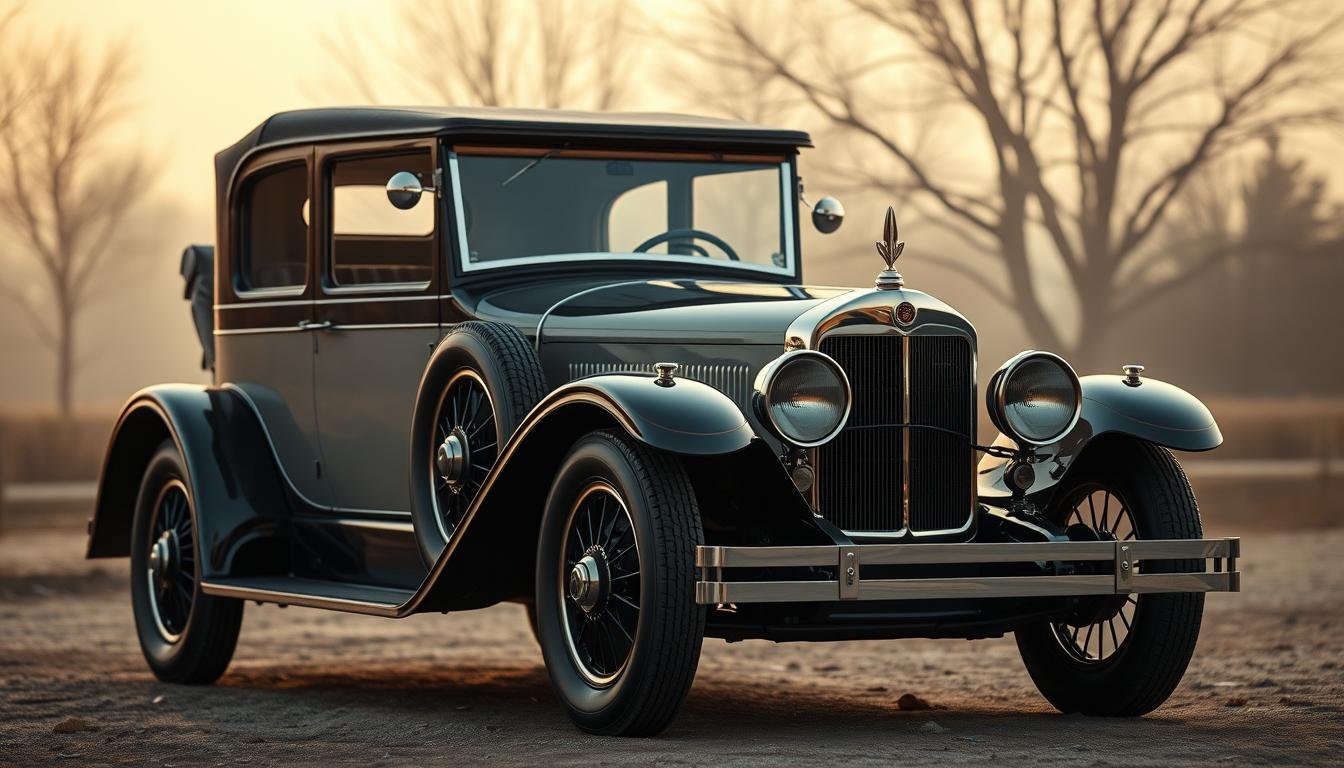

1921 Lincoln Model L: The Classic That Defined American Luxury
In 1920, the Lincoln Model L made its debut, marking a significant moment for Lincoln Motor Company. It was the first vehicle from the company and a bold step into the world of luxury automobiles of the 1920s. This american luxury cars pioneer had a 357.8-cubic-inch V8 engine, producing 90 horsepower. It set new standards for power and craftsmanship.
Produced until 1930, the Model L became a symbol of elegance. It paved the way for Lincoln’s rich legacy. Despite facing financial hurdles, its hand-built coachwork and elite appeal made it a standout in lincoln model l history. It influenced many automotive innovations over the years.

Key Takeaways
- The 1921 Lincoln Model L launched in 1920 as Lincoln’s first vehicle, blending power and luxury.
- Its 90-horsepower V8 engine and handcrafted coachwork rivaled Cadillac and Packard.
- Produced until 1930, it helped establish Lincoln as a leader in american luxury cars.
- Despite financial challenges, Ford acquired Lincoln in 1922, preserving its legacy.
- Today, Lincoln continues its heritage with upcoming electric vehicles, aligning with a 2030 fully electrified lineup.
Introduction to the 1921 Lincoln Model L

In 1917, Henry M. Leland started Lincoln Motor Company to make Liberty aircraft engines for World War I. After the war, he wanted to create a car that would change 1920s American luxury cars. The 1921 Model L was born, combining precision engineering with luxurious design.
The Birth of an American Icon
Lincoln Motor Company’s history began with war efforts, not cars. Henry Leland’s Henry Leland Lincoln Legacy grew as luxury car demand rose after the war. The Model L, launched in 1921, was the brand’s first passenger car. It had a 60-degree V8 engine, a bold choice at the time.
Its 357.8-cu-in engine produced 81 horsepower, setting a new standard for power and elegance.
Henry Leland’s Vision for Luxury
Leland aimed for perfection in engineering. The Model L’s Lincoln Model L design focused on durability and innovation. It had features like hydraulic shock absorbers and a sealed cooling system, showing Leland’s belief in reliable luxury.
He also offered 15 body styles and chassis options, priced from $4,000 to $4,600 (about $70,515–$85,670 today). This showed his commitment to customization.
The Model L’s Place in Automotive History
By 1923, Lincoln produced 6,583 Model L units, marking a significant rise. Its success helped shape the 1920s American luxury cars market. The Model L had a 130-inch wheelbase and features like an automatic tire pump, showing Leland’s focus on driver convenience.
The Model L’s legacy as a symbol of early 20th-century automotive excellence remains strong.
| Year | Units Produced |
|---|---|
| 1921 | 2,957 |
| 1922 | 5,647 |
| 1923 | 6,583 |
| 1924 | 8,440 |
| 1925 | 8,712 |
| 1926 | 7,149 |
| 1927 | 6,362 |
| 1928 | 7,566 |
| 1929 | 2,044 |
Historical Context: America’s Roaring Twenties and Luxury Automobiles

The 1920s saw a big economic boom, making high-end cars a status symbol. The early american luxury car industrythrived, with the lincoln model l in the roaring twentiesleading the way. At the model l at the 1921 auto show, it wowed everyone with its craftsmanship and V8 engine. This showed Lincoln’s goal to compete with European luxury brands like Rolls-Royce.
The Post-War Economic Boom
After World War I, people turned to buying consumer goods. Lincoln Motor Company, which made over 6,500 Liberty V12 aircraft engines, started making cars. The 1921 Model L was its first car, showing how fast Lincoln adapted to the new era of wealth.
The Rise of the American Elite Class
Industrialists and financiers got richer, creating a demand for luxury items. The Model L’s fancy interiors and custom designs were a must-have for the elite. Its $5,000 price tag, about $75,000 today, showed it was a top choice in luxury cars.
Competing Luxury Marques of the Era
| Model | Engine | Price |
|---|---|---|
| Lincoln Model L | 60-degree V8 | $5,000 |
| Packard Twin Six | 12-cylinder | $6,000 |
| Rolls-Royce Silver Ghost | 6-cylinder | £1,000+ (exported to US) |
The lincoln model l vs packard twin sixshowed two different engineering styles. Lincoln used a compact V8, while Packard went for a bigger engine. The lincoln model l vs rolls royce silver ghostcompetition highlighted American innovation against British tradition. At the 1921 auto show, the Model L’s performance and price made it a strong contender in the luxury car market.
The Visionary Behind the Machine: Henry Leland’s Legacy
Henry M. Leland was the genius behind the Lincoln Model L. Born in England, he became a key figure in American car history. His life’s work was about precision and quality.
After starting Cadillac in 1902 and selling it in 1909, Leland focused on henry leland lincoln legacy. At 74, he led Lincoln Motor Company. His goal was to merge lincoln model l engineering with top-notch craftsmanship.
His work at Cadillac showed his vision for quality. This vision guided the Model L. The car’s 60-degree V8 engine was a sign of his innovative spirit. The Model L was a symbol of engineering excellence, as Leland said, “Quality is never an accident.”

Leland’s impact went beyond mechanics. He focused on lincoln model l henry leland’s core values: reliability and performance. His attention to detail made the Model L a luxury car standard.
Even after selling Lincoln to Ford in 1922, his influence remained. The 1921 Lincoln Model L shows Leland’s belief in engineering excellence. His legacy is seen in every part of this car.
Engineering Marvel: The Model L’s 60-Degree V8 Engine

The lincoln model l 60-degree v8 changed car engineering with its small yet strong design. It mixed new tech for both power and smoothness. This made it a top choice for luxury cars back then.
Technical Specifications and Performance
The lincoln model l engine had a 357.8 cubic-inch displacement and 90 horsepower. This was a lot for its time. Its 60-degree angle reduced shake and boosted efficiency. Here are its main details:
| Specification | Detail |
|---|---|
| Engine Type | 60-degree L-head V8 |
| Displacement | 357.8 cu in (5.9 L) |
| Power Output | 90 hp |
| Configuration | Inline cylinder heads, side valves |
Innovative Features for the Time
Engineers came up with fork and blade connecting rods. This made the engine smaller but kept its power. The design was smoother than other V8s back then. Key features included:
- 60-degree cylinder angle for balance
- Forgedd steel crankshaft for durability
- Oil bath air cleaner for filtration
Reliability and Durability Factors
The engine was made with top-quality steel for lasting performance. Its 5.9L displacement and strong build meant it worked well over long trips. People who owned it needed little maintenance, which was rare in the 1920s.
These features made the lincoln model l a leader in V8 designs. Its engineering legacy shows Henry Leland’s dream for car excellence.
Craftsmanship and Design Elements of the Lincoln Model L
The Lincoln Model L was a symbol of wealth. It came in 15 different body styles, each one unique. Its design mixed old-world charm with modern luxury, making it unforgettable.

Exterior Styling and Bodywork
Angus Woodbridge designed the Lincoln Model L. He focused on balance and elegance, avoiding bold looks. The body was made with care, using hand-beveled panels and brass. This made each car special, even if some thought it was too traditional.
Luxurious Interior Appointments
The inside of the Lincoln Model L was all about luxury. It had leather seats stitched by hand and walnut trim. The doors were extra quiet, thanks to special seals. Buyers could choose their wood and adjust the seats, making it truly their own.
Customization Options for Elite Buyers
For those who wanted something special, the Model L offered many choices. You could pick from roadsters, broughams, or touring sedans. Even back in 1921, a Town Car cost $6,600, which is over $116,000 today.
| Body Style | Features | Price Range |
|---|---|---|
| Town Car | Formal chauffeur-driven layout | $6,600 (1921) |
| Phaeton | Open-air convertible | Custom pricing |
| Brougham | Luxury seating, enclosed cabin | High-end pricing |
Building a Lincoln Model L took over 200 hours. This made every car unique. It was the ultimate in personalization during the Jazz Age.
The Manufacturing Process: Hand-Built Excellence
Every 1921 Lincoln Model L started as a bare chassis in Lincoln’s Detroit factory. The lincoln model l assembly process focused on precision, not speed. Artisans combined engineering and artistry in each vehicle.
The lincoln model l factory details highlighted small-batch production. This was a big contrast to the mass production of the 1920s.

Coachbuilders like LeBaron, Judkins, and Holbrook used lincoln model l coachbuilding techniques for custom bodies. They used materials like hand-finished mahogany, hand-stitched leather, and polished brass. Engines were built with heat-treated steel frames for strength and durability.
Every part, from engine parts to upholstery, was carefully inspected. This showed Henry Leland’s commitment to precision. Each Model L became a symbol of exclusivity.
Today, surviving Model Ls show the skill of Detroit’s early-20th-century artisans. They combined innovation with lincoln model l hand-built craftsmanship for wealthy clients.
Driving Experience: Behind the Wheel of the 1921 Lincoln Model L
Getting into the Lincoln Model L is like stepping into luxury. Its 60-degree V8 engine, making 90 horsepower, made it stand out on the road. The car’s smooth engine showed its Lincoln Model L reliability and precision.

Performance Characteristics
The Lincoln Model L handling capabilities were improved by hydraulic shock absorbers. These early innovations made the ride smoother and more controlled. With a weight of 4,000 pounds, the Model L’s acceleration was perfect for long drives.
Comfort and Ride Quality
- Hydraulic suspension systems gave a Lincoln Model L smooth ride, smoothing out rough roads.
- Leather seats and a spacious cabin made long trips comfortable for passengers.
The Driver’s Perspective
Drivers sat high, with great visibility and easy controls. The wooden steering wheel and manual gearshift required focus. Yet, the Lincoln Model L reliability made it reliable. Drivers praised its stability at 60 mph, a rare feat for its time.
Ford’s Acquisition: How the Blue Oval Saved Lincoln
The Lincoln Motor Company was known for its engineering skills but struggled financially. By 1922, the company was on the brink of collapse due to economic pressures and tax issues. Henry Ford purchase of lincoln happened on February 4, 1922, for $8 million, a much lower price than Henry Leland’s $16 million estimate.
The sale, approved by Judge Arthur J. Tuttle, was a turning point for Lincoln.

After Ford took over, lincoln model l evolution started right away. Edsel Ford, Henry’s son, led the design and production changes. In 1923, hydraulic shock absorbers were introduced, making the ride smoother.
Cost-cutting efforts reduced manufacturing costs by $1,000 per car. This ensured lincoln model l ford production influence on future models. Edsel focused on making cars elegant yet affordable, blending luxury with mass production.
| Aspect | Pre-Acquisition (1921) | Post-Acquisition (1922–1923) |
|---|---|---|
| Ownership | Henry Leland | Ford Motor Company |
| Financial Status | Near bankruptcy | Stabilized with Ford’s capital |
| Key Innovations | Original V8 engine | Hydraulic shocks, streamlined manufacturing |
| Leaders | Leland’s team | Edsel Ford + Ernest Kanzler |
Henry Leland left after disagreements with Henry Ford, but the lincoln model l ford acquisition saved Lincoln. Edsel’s designs kept the Model L’s prestige while fitting Ford’s production scale. This partnership made Lincoln Ford’s top luxury brand, combining engineering with mass production.
Market Reception and Commercial Impact
The Lincoln Model L hit the market in 1920 and quickly became a status symbol for the 1920s elite class. By 1921, it had sold 2,957 units, showing it had a loyal following among the rich. Ads at the time highlighted its luxury, aiming at those who saw it as a sign of wealth and new ideas.

After Ford bought it in 1922, sales jumped 45% by 1923, hitting 7,875 units. This increase was thanks to smart marketing that appealed to the growing middle class while keeping its Lincoln Model L impact on Lincoln vehicles. The brand’s focus on making each car special and its engineering excellence paved the way for future Lincolns.
| Year | Production |
|---|---|
| 1920-1921 | 2,957 units |
| 1923 | 7,875 units |
Ads from back then talked up its V8 engine and fine craftsmanship, aiming at the wealthy. Dealers saw the Model L as key for those wanting to show off their status. This success helped Lincoln stay in the luxury car market, influencing models like the K-series and Zephyr. Today, Model Ls are highly sought after, showing their lasting impact on American car culture.
Comparing the Lincoln Model L to Its Contemporaries
The 1921 Lincoln Model L entered a fiercely competitive luxury market. Its 60-degree V8 engine with 90 HP challenged rivals like the Cadillac Type 61 and European giants such as Rolls-Royce. This section breaks down how Lincoln’s engineering stacked up against top competitors.

Lincoln vs Cadillac: An American Luxury Rivalry
The Lincoln vs Cadilac rivalry centered on engine innovation. While Cadillac’s Type 61 relied on smooth 6-cylinder power, Lincoln’s V8 set new benchmarks. Both brands targeted wealthy buyers but differed in approach: Cadillac emphasized refinement, while Lincoln prioritized raw power. The Model L’s 5.9L V8 outclassed the Type 61’s 5.0L engine, with 90 HP versus 64 HP in the Cadillac.
Model L Against Other Premium Marques
- In the Lincoln Model L vs Packard Twin Six, Lincoln’s V8 delivered comparable power to Packard’s 12-cylinder engine at half the weight.
- Against the Lincoln Model L vs Duesenberg Model A, Lincoln’s assembly-line production undercut Duesenberg’s hand-built exclusivity.
- Compared to the Lincoln Model L vs Pierce-Arrow, Lincoln’s $3,750 price tag undercut Pierce-Arrow’s $10,000 bespoke models.
Price Point and Value Proposition
Lincoln positioned the Model L as a value leader. At $3,750, it undercut the $8,000 Pierce-Arrow while matching Cadillac Type 61 performance at a lower cost. Buyers got a 60-degree V8 with a 30-year warranty on parts—unmatched by rivals. This strategy helped Lincoln gain traction against established names like Rolls-Royce and Mercedes-Benz.
Notable Owners and Cultural Significance
The 1921 Lincoln Model L was a symbol of prestige in the 1920s elite class. Famous people like President Warren G. Harding and Henry Ford’s friends owned these cars. This made the Lincoln Model L a status symbol. It was seen as a sign of power and wealth.
Police started using the Model L’s “Police Flyers” version in 1924. These cars had special features like four-wheel brakes and bulletproof windshields. They were key in historical events like Prohibition-era patrols. Their tech, like automatic windshield wipers, raised the bar for police cars everywhere.

In classic Hollywood, the Model L was seen in movies and photos, showing glamour. Stars and directors picked it for scenes needing luxury. Magazines like Motor Age called it “the car that turned heads at society events,” showing its high-class appeal.
- Used by U.S. presidents and industrial titans
- Police Flyers pioneered safety tech for law enforcement
- Featured in 1920s films as a mark of success
By the 1920s, having a Lincoln Model L was more than just a car—it was a statement. Its legacy connects car innovation with the era’s cultural dreams.
Evolution and Refinement: Model L Changes Through Production
The Lincoln Model L changed a lot from 1921 to 1930. It got year-by-year improvements and technical upgrades to stay ahead. Its chassis design stayed the same, letting people choose from different body customization options like roadsters and sedans. Here’s how it evolved:

| Year | Key Changes |
|---|---|
| 1924 | Nickel-plated radiator shell, standard front/rear bumpers |
| 1925 | Removed cowl lights |
| 1927 | Four-wheel mechanical brakes |
| 1928 | Larger 6.3L engine (no HP gain) |
| 1929 | Safety glass and dual windshield wipers |
| 1930 | Last year; minor interior updates |
Technical Upgrades and Enhancements
Big technical upgrades were the 1927 four-wheel brakes and 1929 safety glass. In 1928, the engine got bigger, but horsepower stayed the same. These changes made the car better without making it too different.
Production Numbers and Variants
How many cars were made showed what people wanted. There were small roadsters and big limousines for the rich. The chassis design allowed for 18 different styles, from coupes to phaetons. Though exact numbers are hard to find, 1929 made 1,623 cars, fewer than before.
These updates helped Lincoln keep improving slowly. This made the Model L a key part of luxury car history.
The Collector’s Perspective: Model L in Today’s Market
The Lincoln Model L is a rare gem in the lincoln model l vintage car market. Its lincoln model l rarity makes it highly valuable to collectors. At lincoln model l classic car auctions, rare models like the 1926 7-Passenger Touring sell for high prices. Sales at RM Sotheby’s and Mecumm show its lasting appeal, with well-kept models reaching six figures.

The Model L’s engineering legacy and historical milestones make it a key part of American car history. Its rarity and innovation ensure it remains a solid lincoln model l investment.
Value is influenced by originality, history, and condition. Collectors look for unrestored cars with documented pasts. For example, the 1926 Touring model from the Indianapolis Motor Speedway Foundation, kept in great shape, holds its value well. The 1929 models, with only 2,044 made, are extremely rare.
- Rarity: 1929 models (2,044 made) and custom body styles are most sought-after
- Provenance: Ownership by famous people or long-term care boosts value
- Condition: Cars with original engines and unchanged bodies get higher prices
For those looking to invest in the lincoln model l investment, focus on cars with documented histories. With under 10,000 Model L units made, each car is a piece of history. The 2022 Lincoln Homecoming event showed that demand is high, keeping this classic valuable in collector circles.
Restoration Challenges and Considerations

Restoring a 1921 Lincoln Model L is a big task. Lincoln model l vintage parts sourcing is a major challenge. Finding original parts requires searching through specialist suppliers or lincoln model l restoration communities like the Lincoln Motor Car Foundation. The goal is to meet high standards, from engine work to wood preservation.
Sourcing Original Parts
Finding authentic parts is key. The Lincoln Motor Car Foundation is a big help. They host events like the 2022 Centennial Homecoming. Members get access to resources for rare parts like cylinder heads or body panels.
The Foundation’s museum has archives for lincoln model l restoration projects. They even have a 1922 limousine in their collection.
| Challenge | Impact |
|---|---|
| Wooden Frame Rot | Structural repairs require skilled carpentry |
| Engine Components | Fork and Blade connecting rods often need custom machining |
| Upholstery | Hand-stitched leather and wool fabrics add $2,000+ |
Authenticity in Restoration
Concours restoration means following 1920s rules. Restorers must use original finishes and upholstery. Engine work must keep the V8’s historic look but also be safe to drive.
The Foundation’s 1,000+ Facebook followers share tips for keeping it authentic.
Cost Considerations for Modern Collectors
Restoring a Lincoln model l can be expensive. Labor costs are over $100/hour, and hidden rust repairs can add $130,000+ to the budget. Restorations take 6-12 months, which is longer than expected.
The Foundation’s $1.6M endowment helps members with educational resources and parts exchanges.
“Restoring a Model L is a labor of love requiring patience and planning,” says a Foundation member.
The Legacy of the 1921 Lincoln Model L in Automotive History
The Lincoln Model L is a key part of car history. It set high standards for engineering and design that are seen today. With its 60-degree V8 engine and $4,300 price in 1921, it changed what luxury cars could be.
Today, cars like the Aviator and Navigator keep the Model L’s spirit alive. They offer quiet, refined rides and new tech.

“Lincoln’s roots in classic craftsmanship and forward-thinking innovation guide our path to a fully electrified lineup by 2030,” says the brand’s vision.
The Model L’s impact is celebrated at events like Pebble Beach Concours d’Elegance. Restored Model Ls show its groundbreaking role. Modern Lincolns have advanced tech, but they keep the excellence of the Model L.
| Feature | 1921 Model L | 2023 Lincoln Aviator Grand Touring |
|---|---|---|
| Engine | 60-degree V8, 357.8 CID | 3.0L twin-turbo EcoBoost + hybrid |
| Horsepower | 90 hp | 491 hp (combined) |
| Price (then/now) | $4,300 | $63,000+ |
| Electrification | None | Plug-in hybrid (PHEV) |
Looking at the Lincoln Model L vs modern Lincolns, we see a big leap in power. From 90 horsepower to 491 horsepower, it’s a big jump. Lincoln aims for 50% electric sales by 2025, keeping the Model L’s spirit alive.
Conclusion: How the Model L Shaped Lincoln’s Future and American Luxury
The 1921 Lincoln Model L set a high standard for luxury cars. Its V8 engine and careful design led the way in American luxury car making.
Later models, like the 1961 Continental and the 1977 Versailles, followed its lead. They added new features, like coach doors and garage door openers. The 2010 MKZ Hybrid shows how these traditions meet today’s technology.
The Model L’s mix of power and style has made a lasting mark on Lincoln. It shows how Lincoln stays at the top in luxury car making. Its influence can be seen in cars like the MKZ Hybrid, showing its lasting impact on car history.
FAQ
What were the revolutionary features of the 1921 Lincoln Model L?
The 1921 Lincoln Model L had a 60-degree V8 engine. It also had a strong chassis and luxurious interiors. These features made it stand out from other cars of its time.
How did Henry Leland influence the design and manufacturing of the Lincoln Model L?
Henry Leland came from Cadillac with a focus on quality and reliability. He brought this to Lincoln. This focus helped make the Model L a top choice.
What role did the post-war economic boom play in the success of the Lincoln Model L?
After the war, people had more money to spend on luxury items. This boom helped the Model L become popular. It became a symbol of status for the growing American elite.
How does the Lincoln Model L compare to its luxury competitors, such as Cadillac and Packard?
The Model L and cars like the Cadillac Type 61 were known for their engineering. But the Model L had unique designs and options. These made it a favorite among the wealthy.
What has been the collector’s interest in the Lincoln Model L today?
Today, the Model L is highly sought after. Its rarity, history, and craftsmanship make it valuable. It’s a great investment for car lovers.
What are some modern restoration challenges faced by owners of the Lincoln Model L?
Restoring the Model L can be tough. Finding original parts and keeping the car authentic is hard. It also costs a lot and requires special knowledge.
How did Ford’s acquisition of Lincoln affect the development of the Model L?
When Ford bought Lincoln, Edsel Ford made changes. He improved the Model L’s appeal without losing its quality. This made the car even more popular.
What makes the Lincoln Model L significant in American automotive history?
The Model L made Lincoln a respected luxury brand. Its design and engineering set the stage for future Lincolns. It’s a key part of American car history