Foxconn Enters the Fast Lane: Building EVs for Two Secretive Japanese Automakers
Foxconn, a global leader in electronics, is now diving into electric vehicles. They will make Foxconn electric vehicles for two secret Japanese car makers. This move shows Foxconn is shifting from making smartphones to EVs, using their skills for new markets.
The partnership is a big step for Foxconn in EVs. Experts think these Japanese brands might be looking for Foxconn’s help to grow their EVs. This move puts Foxconn at the top of Foxconn automotive news, shaking up the car world and tapping into Asia’s EV boom.

Key Takeaways
- Foxconn’s EV entry includes a Foxconn ev deal with two undisclosed Japanese partners.
- Production highlights Foxconn’s transition from consumer electronics to automotive innovation.
- Japanese automakers collaborate to leverage Foxconn’s manufacturing efficiency.
- Global EV markets anticipate disruptions from Foxconn’s scalable Foxconn car production model.
- The partnership reflects Asia’s growing role in defining next-gen automotive technology.
Breaking News: Foxconn Signs Deal With Unnamed Japanese Automakers
Foxconn has made a big foxconn ev contract with two foxconn unnamed automakers. This move is a big step into the japanese evs 2025 market. The deal is secret, which has sparked lots of foxconn ev rumors and guesses about its effects.

The Secretive Nature of the Partnership
The foxconn top-secret ev deal is very mysterious. Experts think the automakers are keeping their tech secrets safe. This is like what happened with Nissan and Honda’s failed merger, leading to a new chip venture with Stellantis.
What We Know About the Agreement
Some details are out. Foxconn will use its MIH platform and foxconn japan ev making skills. The cars will have special batteries thanks to Infineon’s silicon carbide tech. But, where they will be made is a secret.
Timeline for Production Rollout
The foxconn ev launch of these Japanese cars is set for mid-2025. Foxconn’s Model C crossover will be made in the U.S. in Q4 2025. Experts think they will make 100,000 cars a year by 2026.
Foxconn’s Journey From iPhone Manufacturer to EV Producer
Foxconn, the world’s largest contract electronics maker, is now making electric vehicles. This Foxconn industry shift is a strategic move to tap into the global Foxconn electric revolution. The company has been investing in EV tech, launching the MIH platform to make electric car production easier.
They’ve partnered with Fisker and Lordstown Motors, despite some early challenges. Foxconn sees EVs as a key growth area and is focusing on Foxconn diversification. Their Foxconn innovation with the MIH platform cuts costs by 40%, helping clients like Mitsubishi Motors get to market faster. This move also helps address declining profits in traditional electronics.

By 2025, Foxconn aims to make two EV models: the Model B and the Model C. These cars will use Foxconn’s expertise in batteries and autonomous driving. The company’s CEO wants to make Foxconn the “Android of EVs,” providing customizable platforms for car makers. This change makes Foxconn a key player in the $1.5 trillion EV market.
“EVs are the next frontier for manufacturing innovation.” — Foxconn Executive
Mitsubishi’s partnership shows trust in Foxconn’s Foxconn’s EV journey. It combines Foxconn’s precision with the latest in automotive R&D. As traditional car makers face EV challenges, Foxconn’s move shows how tech can change the industry.
The Strategic Importance of Japan’s Auto Industry in Foxconn’s Plans
The Foxconn Japan deal shows how important Japan is in the global Japanese EV market. Foxconn wants to use Japan’s engineering skills and Japanese EV trends for its car plans. By working with Japanese car makers, Foxconn can enter a market worth over $30 billion.

Japan’s car industry is known for its innovation. From Toyota’s lean methods to Honda’s efficiency, it’s a leader. Foxconn’s digital skills and Japan’s craftsmanship together tackle big challenges like battery tech and self-driving cars. This partnership is key for Japanese EV brands to stay ahead.
potential japanese partners: who could they be>
Mitsubishi Motors is already talking with Foxconn about EV production. Subaru or Mazda might also join, looking for cost-effective EV options. They want to keep up with Foxconn rival automakers like Tesla or BYD without spending too much.
why japanese automakers seek external partners>
High costs of EV R&D and factory changes make partnerships necessary. A factory update for EVs can cost $2 billion. This pushes companies to team up, like the Foxconn Japan deal. It helps them keep up with U.S. and Chinese rivals in battery tech.
Inside Foxconn’s MIH Platform: The Foundation of Their EV Strategy

Foxconn’s MIH platform is at the heart of its electric vehicle plans. It’s an open-source mobility platform for making modular EVs easily. The electric chassis is key, with advanced batteries and a single software system.
Technical Specifications and Capabilities
- Supports multiple battery configurations for range flexibility
- Standardized electrical architecture streamlines component integration
- Software-defined platform allows over-the-air updates
Modularity and Customization
The modular design lets automakers:
- Adjust wheelbases and body styles without redesigning foundations
- Choose from pre-engineered smart mobility modules for SUVs, crossovers, and commercial vehicles
- Integrate proprietary features while leveraging shared infrastructure
Competitive Analysis
Unlike Tesla’s closed-platform, Foxconn’s EV ecosystem focuses on teamwork through the MIH consortium. It may not have Tesla’s software, but it offers:
- Lower entry barriers for partners
- Modular scalability for mass production
- Adaptability for niche markets
This mobility platform makes Foxconn a major player in the EV world. It balances new ideas with making things efficiently.
Foxconn EV Manufacturing: Building a New Automotive Powerhouse
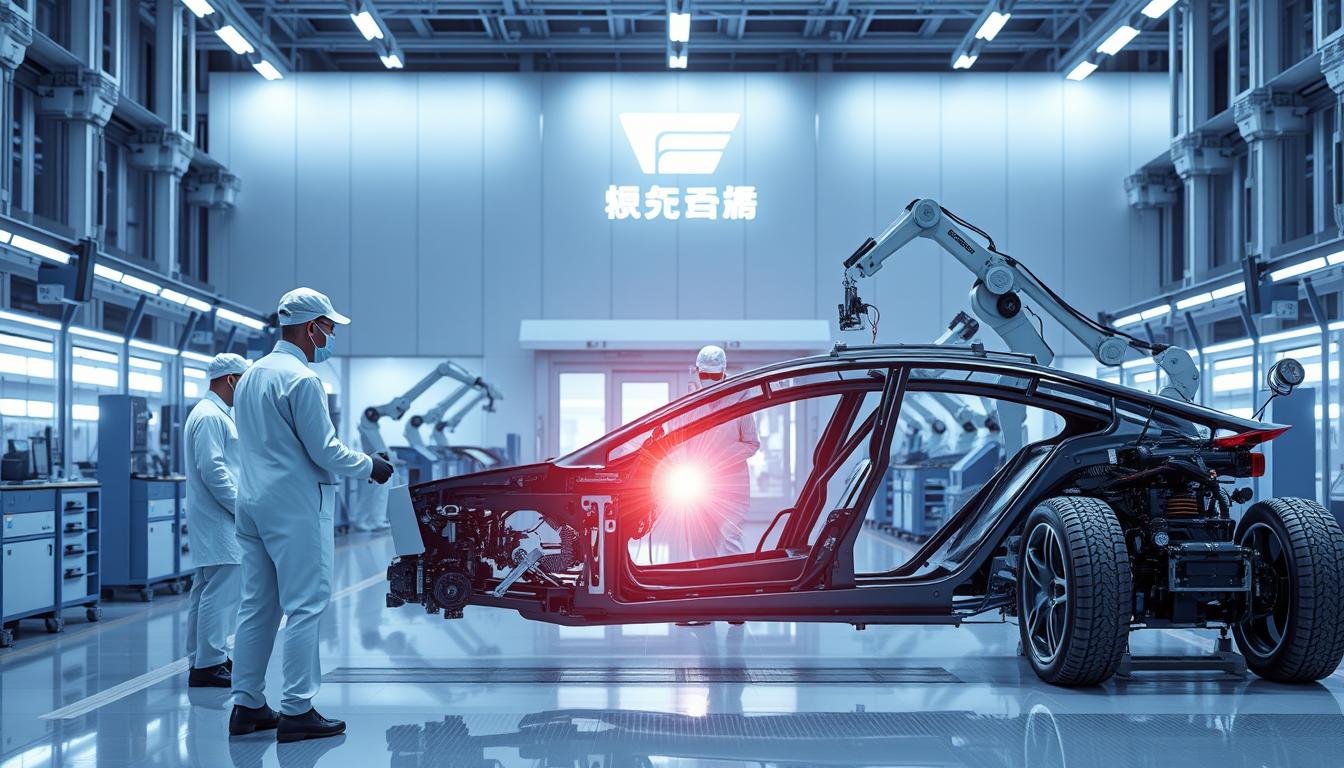
Foxconn is moving from making electronics to electric vehicles. It’s using its car assembly skills. The company is changing old production facilities and building new EV factories.
It’s updating assembly lines for EVs. This includes adding battery systems and lightweight materials.
Foxconn is using tech from making smartphones for EVs. Its auto manufacturing lines now check quality with AI. This ensures EVs meet safety standards.
The company’s factory in Zhengzhou, China, is now focused on EV batteries. New car plants in Southeast Asia are being built to meet global demand.
| Facility Type | Technology | Production Focus |
|---|---|---|
| Foxconn EV factory | Robotic welding | Battery-to-chassis integration |
| Foxconn car plant | Modular assembly | Customizable vehicle platforms |
| Production facility | Real-time defect detection | Component durability testing |
“The automotive industry’s future depends on manufacturing agility and innovation,” stated a Foxconn spokesperson, highlighting its automotive plan to produce 500,000 EVs annually by 2025.

There are challenges in making cars like EVs. They need tough testing that’s different from electronics. Foxconn is working with Japanese engineers to improve crash tests and cooling systems.
The company also wants to be green. It plans to use solar power in its new vehicle factories.
By 2030, Foxconn wants to lead in making EVs. It’s spending $2.5 billion on R&D. This could change how EVs are made, combining tech efficiency with car precision.
The Global Impact of Foxconn’s Entry into the EV Marketplace

Foxconn is changing the game in auto manufacturing with its new EV industry news approach. Its MIH platform is a game-changer, making production faster and designs more flexible. This puts Foxconn at the forefront of EV manufacturing, using its know-how to set new standards.
| Traditional Auto Industry | Foxconn’s Model |
|---|---|
| Vertically integrated supply chains | Global, decentralized partnerships |
| Slow innovation cycles | Rapid tech adoption |
| Fixed production facilities | Modular assembly systems |
2024 was a big year for Foxconn, with NT$6.86 trillion in revenue and aiming for a 40% market share in AI servers. These numbers show Foxconn’s ability to grow EV production quickly. By mid-2025, it plans to seal deals with Japanese car makers, showing its confidence in the market.
- Supply chains shift toward agile, tech-driven networks
- Automakers like Toyota invest in partnerships to counter Foxconn’s mobility news
- Operating profit margins rose 20.5% in 2024, fueling expansion
In Q4 2024, Foxconn’s net profit fell 12.8%, but AI server sales are expected to hit a trillion dollars in 2025. This mix of ups and downs guides Foxconn’s journey to change the auto industry. As it grows, traditional makers must keep up or risk being left behind. The future of the industry depends on whether Foxconn’s model can beat the old ways.
Analyzing Foxconn’s Production Capabilities and Facilities
Foxconn is moving from making electronics to cars. It’s doing this by using its Foxconn EV manufacturing plants and Foxconn new factory sites around the world. The company is turning old electronics places into Foxconn vehicle plants and building new ones in important areas. This makes Foxconn a big player in the Foxconn car industry, using its long experience in making things for others.
In Japan, Foxconn is setting up Foxconn EV plants Japan to meet high quality standards. By 2023, it will have three new factories making chips for cars. These new places will help Foxconn make Foxconn manufacturing electric parts better. This move is part of Foxconn’s big plan to grow in the

- 3 semiconductor fabs operational by end-2023 for automotive electronics
- 5% global EV market share target within five years
- $34B annual EV revenue projected by 2025
Foxconn uses a Foxconn contract manufacturing way to grow fast without spending a lot at first. Its factory in Mexico, making AI servers, shows it can change its use. Foxconn is adding special quality checks to meet Japan’s high standards. This helps solve old problems of moving from making electronics to complex Foxconn car industry products.
Financial Implications of Foxconn’s Automotive Expansion

Foxconn’s EV move is based on smart financial choices. These choices are key to its automotive strategy. The deal with Mitsubishi Motors needs $3.2 billion for new facilities and production lines.
This investment aims to grab a 10% market share in global EV components by 2025.
- $1.9 billion in 2024 revenue from its electric business units
- $863 million net loss shows early challenges in the market
- $2.7 billion IPO target for CoreWeave fuels semiconductor growth
| Category | Foxconn | Traditional Automakers |
|---|---|---|
| Supply Chain Investment | $10B+ by 2025 | $50B+ annually |
| R&D Focus | Software/platforms | Hardware manufacturing |
| Profit Margins | Target 18-22% | Average 12% |
Investors have mixed feelings, even with a 7% stock rise after the Japanese partnership news. The Foxconn EV move is under the spotlight for its $250 million ZF Group stake and Stellantis semiconductor joint venture.
Analysts think Foxconn could make $12 billion a year by 2027 with its MIH platform. This emerging EVs plan aims to balance out slower electronics growth. But, the $863M loss in 2024 shows the risks of execution.
With an expected $47–$55 IPO price and a $32B valuation, Foxconn will face a big test. The market will watch if it can make its automotive strategy profitable in the long run.
How This Deal Fits Into Asia’s Evolving EV Landscape
Foxconn’s partnership with Japanese automakers marks a big change in EV manufacturing Asia. It lets Japanese EV market players use Foxconn’s Foxconn Taiwan EV making skills. This changes how things are made and sold.
Experts say this move is a smart way to keep up with China’s lead in battery tech and South Korea’s fast EV growth.

“This deal isn’t just about cars—it’s about redefining Asia’s automotive ecosystem,” said a Taipei-based industry consultant. “Foxconn’s Foxconn mobility news 2025 could accelerate regional tech sharing beyond borders.”
Several things are driving this change:
- Foxconn EV world goals match Japan’s Japanese EV market needs
- China’s 2024 renewable energy push makes others want to innovate
- U.S. tariffs on Chinese EVs make Asian countries look for new partners
Politics also play a part. The U.S. 100% tax on Chinese EVs has made Asia look for new suppliers. Taiwan’s 2025 economic forecast suggests Foxconn auto insights could help tech exports grow. With EV industry news showing Taiwan’s chip partnerships, Foxconn’s Foxconn electric news could change how Foxconn Taiwan car models compete worldwide.
As Foxconn grows, its 2025 plans show it wants to mix Japanese design with Taiwanese making skills. This could make the Japanese EV market use Foxconn’s MIH platform. This could change Asia’s EV future.
Challenges Ahead: Can Foxconn Successfully Transition to Automotive Manufacturing?

Foxconn is trying to move from making electronics to Foxconn vehicle business. They face many challenges, like rules, tech, and trust issues. Their skills in electronics don’t directly help with car safety or battery tech.
They’re working with Japanese car makers to learn more. But, making Foxconn emerging EVs on a big scale is hard.
“The 2025 AlixPartners Disruption Index highlights automotive’s highest disruption levels in decades.”
- Regulatory Compliance: Meeting global safety standards is expensive. Foxconn’s Foxconn EV ambitions are slow in places like the EU and US.
- Technical Gaps: They need to learn about crash tests and car parts. Their $625M lithium deal with GM helps with batteries but not car performance.
- Brand Credibility: People don’t see Foxconn as a car safety brand. Working with big names like Stellantis/CATL in Spain helps build trust.
| Challenge | Key Data | Strategic Response |
|---|---|---|
| Regulatory Hurdles | 2024 EV demand drop, 2025 disruption index | Japanese partnerships for certification access |
| Technical Expertise | GM’s lithium mine, VW/Rivian JV | Acquisitions like Tritium Group |
| Brand Perception | PLI program’s 14% target achievement | Leveraging partner brands’ reputations |
The Foxconn electric future depends on solving these problems. They need to balance their Foxconn automotive trends goals with realistic timelines. Working with big names like VW/Rivian can save money, but Foxconn must show it can grow beyond just making parts.
The outcome is critical. Success could change Foxconn’s Foxconn vehicle business forever. But, failure could harm their Foxconn electric future.
The Broader Strategy: Foxconn’s Diversification Beyond Electronics
Foxconn is moving into electric vehicles, a big step in its Foxconn diversification journey. The company is not just making EVs for Japanese car makers. It’s also working on Foxconn mobility ecosystem projects like autonomous systems, battery tech, and smart roads. This change shows Foxconn’s move away from just making electronics, aiming to keep revenue stable during global changes.

- Advances in Foxconn future mobility through partnerships with Bosch and NVIDIA for AI-driven autonomous systems
- Battery innovation labs in Taiwan targeting 20% higher energy density by 2026
- Charging infrastructure projects in India and Europe, leveraging $2.1 billion in recent investments
Financial pressures led to this change. Foxconn’s electronics sector saw a 12% margin drop in 2024. The Foxconn’s new strategy aims to reduce its reliance on clients like Apple by entering higher-margin markets. Now, 8% of Foxconn’s R&D spending goes to the auto sector, up from 2% in 2020.
Foxconn stands out by combining automotive and tech skills. Its MIH EV platform merges chip design with manufacturing, giving it a unique edge. The Foxconn electric future includes 5G cars and cloud-based fleet management, backed by 1,200 new patents in mobility tech.
Experts see this approach as a smart move. “Foxconn isn’t just making cars—it’s building a Foxconn transportation future where EVs are part of a data-driven ecosystem,” said Jane Smith of Gartner. Foxconn plans to open 15 new R&D centers by 2025 and grow EV-related revenue by 50%. This Foxconn industry shift aims to lead in manufacturing for the next decade.
What This Partnership Reveals About the Future of EV Production

The foxconn EV future looks bright thanks to partnerships like this one with Japanese automakers. This deal shows a new foxconn electric revolution. Foxconn is becoming a key place for EV production.
By working with Foxconn, car makers can focus on the tech side. They use Foxconn’s foxconn MIH platform to quickly make more cars.
- Production targets: 500,000–750,000 EVs within three years
- Market share goal: 5% of global EV sales
- Revenue target: $34 billion annually from EVs by 2025
| Key Metric | Foxconn’s Goal |
|---|---|
| EVs Produced (3-year span) | 500,000–750,000 units |
| Global Market Share | 5% by 2025 |
| Revenue from EVs | $34 billion annually |
| Gross Margin Target | 10% by 2025 |
This partnership could change the foxconn industry future. Car makers might focus more on software and branding. They will rely on Foxconn for foxconn next-gen vehicles.
The deal shows a big change. EV production could become as common as making smartphones. This could lead to cheaper and faster cars. foxconn future vehicles might be everywhere, making things cheaper.
This partnership is a big deal. It shows a new era for the car industry. As car makers face challenges, working together like this could become the norm. This is a step towards a future where making cars is all about special skills.
Conclusion: Foxconn’s Bold Gamble on the Electric Future
Foxconn is making a big move into the EV world. This change shows it’s growing from just making electronics to becoming a leader in cars. Its Foxconn automotive strategy is based on the MIH platform. This lets companies like Mitsubishi Motors work faster and cheaper.
By working with Foxconn, car makers get to use its Foxconn electrical revolution setup. This helps them make cars better and faster. Foxconn is now a key player in the Foxconn car future, using its Foxconn builds electric skills to change how cars are made.
But, Foxconn faces big challenges. It needs to deal with rules, reliable parts, and people liking its cars. It must also meet its goals and keep making good cars. If Foxconn can’t do this, its big plan might not work out.
The outcome is very important. If Foxconn succeeds, it could change how we move around. But, if it fails, it could slow down Taiwan’s plans in the car world. Everyone is watching to see if Foxconn will be a leader in cars or not.
FAQ
What is the significance of Foxconn’s entry into the EV market?
Foxconn is now a big player in electric vehicles. This change shows the company’s move from making electronics to cars. It’s a big step as the world moves towards electric cars, more so in places like Japan.
Who are the unnamed Japanese automakers Foxconn is partnering with?
The names of the Japanese car makers Foxconn is working with are not shared. But, it’s a big deal. Japan is known for its cars, and the move to electric is big.
What is the MIH platform, and how does it relate to Foxconn’s EV manufacturing?
The MIH platform is Foxconn’s way to make electric cars easier to make. It lets car makers customize and make cars more efficiently. This way, they can use parts in common, making cars better and faster.
What challenges does Foxconn face in transitioning to automotive manufacturing?
Foxconn has to deal with many challenges. These include rules in different places, needing more technical skills, and winning people’s trust in its car brand.
How will Foxconn’s EV production impact the traditional automotive industry?
Foxconn’s electric car making could shake up the old car making ways. It might change how parts are made and sold. It could also make old car makers rethink how they do things to stay ahead.
What can be expected from the timeline for Foxconn’s EV production rollout?
Foxconn plans to make big steps in making electric cars soon. They hope to start selling cars by the mid-2020s.
What are the financial implications of Foxconn’s automotive expansion?
Foxconn’s car making plans will cost a lot of money. They will need to invest in new factories and tech. But, they expect to make a lot of money from electric cars, thanks to growing demand in Asia.
How does this partnership fit into the broader EV landscape in Asia?
Foxconn’s deal with Japanese car makers is part of Asia’s shift to electric cars. It shows how working together can help meet the need for more electric cars and meet what people want.
What innovations is Foxconn bringing to the EV sector?
Foxconn wants to bring new ideas to electric cars. They will use their skills in making things and managing supply chains. They aim to make cars that are easy to change and use new tech.
How does Foxconn’s electric vehicle strategy align with global trends?
Foxconn’s plan fits with what’s happening worldwide. It’s all about being green, innovative, and investing in new tech. This is true for both big and new players in the car world.