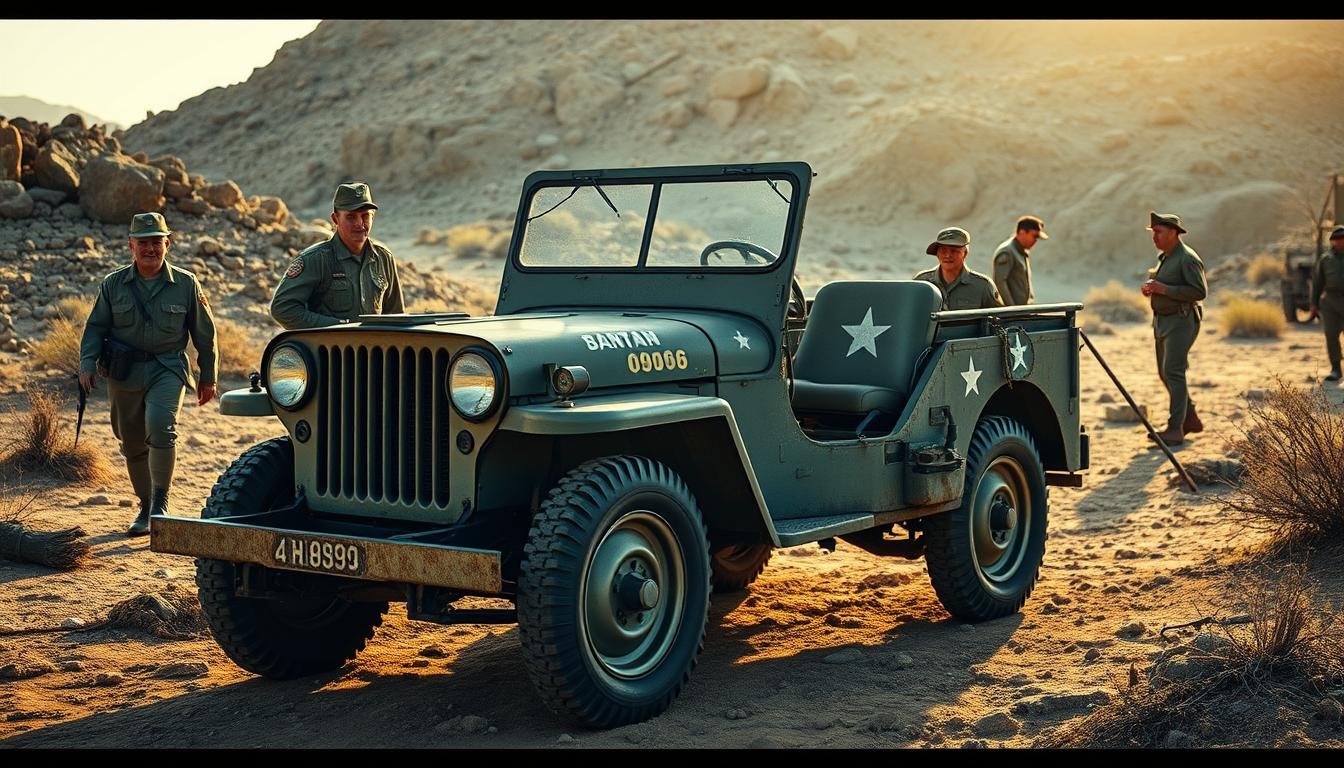

1940 Jeep Bantam BRC: The Original Jeep That Started It All
The 1940 Bantam BRC was the first Jeep, starting a legendary journey. It was made by the Bantam Motor Car Company for the U.S. Army. This small off-road vehicle was needed for a lightweight, all-terrain reconnaissance car.
Though only 2,642 units were made from 1940 to 1943, it set the standard for the Jeep’s iconic design.

In 1940, the Army needed a 590 kg reconnaissance vehicle. Only Bantam and Willys bid. Bantam’s team, led by Karl Probst, made a 922 kg prototype in just 49 days.
Though heavier than expected, the Bantam BRC passed tough tests. It climbed 60-degree slopes and went 5,800 km. This laid the groundwork for the Jeep’s lasting legacy.
The Bantam BRC’s design influenced the Jeep long after Bantam went out of business. Over 650,000 Jeeps were built in WWII, all based on the Bantam’s design. The also helped British and Soviet forces, showing its global impact. Today, its story shows how a small company’s innovation changed automotive history.
Key Takeaways
- The Bantam BRC was the first Jeep prototype, produced from 1940–1943.
- Only 2 companies bid on the Army’s request out of 135 interested automakers.
- Bantam delivered its in 49 days, meeting the Army’s strict deadline.
- Despite bankruptcy, Bantam’s design inspired over 650,000 WWII Jeeps.
- The term “Jeep” originated during Bantam BRC trials, cementing its place in lore.
The Birth of an American Icon: Origins of the Bantam BRC

In 1940, the U.S. Army urgently needed a lightweight wwii jeep origins vehicle. This need sparked a race to redefine military transport. The bantam brc jeep origins began when the Army challenged 135 manufacturers to meet strict requirements. Only three companies answered: Bantam, Willys-Overland, and Ford.
The U.S. Army’s Urgent Need for a Reconnaissance Vehicle
The Army’s 1940 specs demanded a 75-inch wheelbase and 1,200-pound weight limit. The us army vehicle trials 1940 would test prototypes for all-wheel drive and off-road capability. The bantam brc development process prioritized speed and simplicity to meet wartime demands.
American Bantam Car Company’s Bold Response
Despite financial instability, Bantam committed to a 49-day prototype deadline—far faster than rivals’ 120-day requests. This bantam brc jeep origins milestone saw engineers create a working model in record time, proving the company’s innovative drive.
The 49-Day Design Challenge
Bantam’s team delivered a functional prototype in 49 days. The bantam brc military vehicle design passed 1940 trials, though production contracts later went to larger firms. This breakthrough set the stage for the Jeep’s global legacy.
Historical Context: America on the Brink of World War II
In 1940, Europe was in the midst of WWII military vehicles were key. The U.S. Army needed a light vehicle for scouting. By July 1940, they asked 134 car makers for bids. Only two, American Bantam and Willys-Overland, replied, starting the jeep competition 1940.
The predecessor to the jeep, the Bantam BRC, was the result of this urgent race. Engineers had just 49 days to create a prototype. Bantam’s design won the bantam brc government contract, getting an order for 70 vehicles.
This was a big moment for U.S. military buying. The bantam brc testing showed it could handle tough terrain. This success led to mass production.

The vehicle had to have 40 horsepower, weigh 1,300 pounds, and be 4×4. These specs came from Blitzkrieg tactics, focusing on speed and agility. By autumn 1940, the Bantam BRC-40 passed its tests, showing it was ready. This success led to the Willys MA and Ford GPW Jeep models later on.
The Visionaries Behind the 1940 Jeep Bantam BRC

In 1940, the Bantam Car Company had just 49 days to create the Bantam BRC 40. Engineers Karl Probst and Harold Crist made this vision a reality. Their work set the stage for the Willys MB, starting with the Bantam BRC’s groundbreaking.
Karl Probst, a freelance engineer, was the mastermind behind the Bantam BRC. He arrived in Butler, Pennsylvania, on July 18, 1940. In just days, he finished the blueprints for the Bantam BRC 40. Probst even got Spicer drivetrain parts on the way, ensuring the prototype’s core was ready before starting.
Harold Crist’s team had to work fast. With only three engineers, they built the first prototype based on Probst’s designs. They introduced a lightweight engine and four-wheel-drive systems. Despite Bantam’s financial issues, their work passed the Army’s initial tests, making it to government testing.
The Army wanted a vehicle under 1,300 pounds that could reach 50 mph. The Bantam BRC went through tough government testing. Though a rivalry with the Willys MB would come later, the Army approved the Bantam BRC 40’s design. The Bantam BRC engineering team’s work, from Spicer parts to engine improvements, showed that even small companies can innovate.
Design Innovation: Breaking New Ground in Vehicle Engineering
The bantam brc design challenges made engineers question old car-making ways. They aimed to create a small but strong vehicle for the Army. Bantam’s team focused on using light . They built a tubular frame for the , making it both strong and light.
This used Studebaker axles and Spicer joints for tough terrain. A Continental BY-4112 engine gave it reliable power, even with only 48 horsepower.

The were new to meet the Army’s 841 kg weight limit. The first model was heavier, but its system was top-notch. It had independent front suspension and leaf springs for great off-road performance.
Engineers made it both tough and agile. They used high-tensile steel in key areas but kept it light where possible.
| Component | Innovation | Benefit |
|---|---|---|
| Chassis | Tubular frame construction | Lightweight yet rigid structure |
| Suspension | Independent front suspension | Improved wheel contact on uneven terrain |
| Materials | Heat-treated steel panels | Enhanced corrosion resistance |
Every step was about being reliable in the field. Even small touches, like adjustable track width and engine placement, showed Bantam’s impact on military vehicle design. They set the stage for the legendary versatility of later Jeep models.
Technical Specifications and Capabilities of the Bantam BRC
The Bantam BRC is designed for military use. It has bantam brc engine specs and a drivetrain that make it stand out. This vehicle is both powerful and agile.

Engine Performance and Power Output
The Continental BY-4112 engine gives 48 horsepower and 80 lb-ft of torque. It’s perfect for climbing steep hills. The engine runs at 3,200 rpm, great for towing.
The flathead design keeps costs down without losing reliability. This makes the engine efficient and reliable.
Transmission and Four-Wheel Drive System
The bantam brc transmission works with a Spicer transfer case. This allows easy switching between two-wheel and bantam brc four-wheel drive. It’s great for driving on mud, snow, and rough terrain.
A two-speed transfer case helps with steep hills. It makes driving easier in tough conditions.
Weight, Dimensions, and Materials
The bantam brc weight and dimensions are impressive. It’s 128 inches long and 56 inches wide. It weighs 1,800 lbs, under the military limit of 2,400 lbs.
It has a steel tubular frame and aluminum parts. This makes it strong without being too heavy.
Fuel Efficiency and Range
The Bantam gets 15 MPG. It can go 150 miles on a 10-gallon tank. This bantam brc fuel efficiency is key for long missions.
Its small fuel tank helps keep it light. This is important for long trips.
Military Testing: How the Bantam BRC Proved Its Worth
The bantam brc military tests started with a big claim. The prototype drove 275 km to Camp Holabird on its own, showing it was reliable. Then, it went through 30 days of tough tests, covering over 5,800 km on mud, sand, and steep hills.
The bantam brc showed great terrain handling. It climbed slopes over 45 degrees and crossed streams up to 30 cm deep.

Testers pushed the bantam brc to its limits. It towed twice its weight, ran for 12 hours straight, and handled temperatures from -30°C to 50°C. Even when frame cracks appeared, Bantam’s team fixed them in under 24 hours, showing its durability.
Military experts praised its reliability under pressure. They called it “a breakthrough in light reconnaissance vehicles.”
“The bantam brc off-road performance defieds physics,” remarked one Army officer after watching it navigate a 50-km desert loop without mechanical failure.
Despite some issues, the bantam brc’s off-road skills impressed everyone. These tests showed its promise, even though production issues later changed its path. The tests proved the BRC’s worth, even if its story took a different turn.
The 1940 Jeep Bantam BRC: Prototype Evolution

The bantam brc prototype went through three main phases. Each phase was a response to U.S. Army feedback. The first model, the Bantam Model 60, was built in just 49 days. It set the stage for military 4×4 vehicles.
Testing showed that the vehicle needed changes for better performance on rough terrain.
From BRC-60 to BRC-40: Refining the Design
The BRC-60 evolved into the BRC-40 by 1940. This update included stronger sheet metal fenders and a lower front bumper. The bantam brc tires and ground clearance were also improved to 8.5 inches.
Only 2,675 bantam brc total units made were produced. Eight prototypes tested four-wheel steering.
Key Improvements Through Testing Phases
Field trials showed issues with fuel tank placement and engine cooling. The fuel tank was moved under the driver’s seat for better balance. A stronger windshield frame and upgraded suspension were also added.
These changes came from the bantam brc design influence of World War II mobility needs. A table summarizes model comparisons:
| Model | Year | Key Features |
|---|---|---|
| BRC-60 | 1940 | Prototype with rounded fenders, 80hp engine |
| BRC-40 | 1941 | Reinforced fenders, 45-inch wheelbase, improved cooling |
Meeting the Army’s Demanding Requirements
Later versions met the Army’s torque output and weight targets. The bantam brc tires were widened to 6.00-16 inches for better grip. By 1941, the BRC-40 met 90% of the Army’s mobility needs.
This made it a standard for all WWII Jeeps.
“The BRC’s adaptability proved it could outperform horses in North African deserts and European forests,” wrote historian Bill Spear in Warbaby.
Contract Controversy: Why Bantam Lost Despite Being First

Despite being the first to create a Jeep prototype, Bantam faced tough competition from Willys and Ford. The Army shared Bantam’s designs with its rivals, which hurt Bantam’s chances. Bantam’s design met all Army specs, but its small plant couldn’t compete with Ford’s or Willys’ bigger operations.
Production capacity was a big problem. Bantam had only 450 workers and made 1,227 cars in 1939. The Army wanted 75 Jeeps a day, which Bantam couldn’t keep up with. When bidding for 16,000 Jeeps in 1941, Bantam’s $788.32 per Jeep bid was higher than Willys’ $748.74. This made Willys the winner, and they later trademarked the “Jeep” name.
Politics also played a part. The Army’s decision to share Bantam’s designs with competitors was unfair. Willys and Ford used Bantam’s ideas for their own Jeeps. In 1948, the FTC said Willys unfairly claimed to be the Jeep’s inventor, hurting Bantam’s reputation. By the end of the war, Ford and Willys made over 600,000 Jeeps, while Bantam made less than 2,700.
Even though Bantam started the Jeep design, Ford and Willys took over production. The bantam brc vs ford gpw rivalry showed how big companies often get favored over small innovators. Yet, the Jeep’s story is forever linked to this early controversy.
Comparing the Bantam BRC to Its Successors: Willys MB and Ford GPW
The Bantam BRC vs Willys Mb comparison shows early design issues. Bantam’s BRC-40 weighed 1,840 lbs, over the 1,300-lb limit. Willys made it lighter by 240 lbs with a 60-horsepower engine. The Bantam Brc vs Ford Gpw shows similar specs, but Ford produced more for mass use.
Both successors had Bantam’s 75-inch wheelbase and 47-inch track. But Willys’ “Go-Devil” engine became the standard.

| Model | Engine | Weight (lbs) | Production |
|---|---|---|---|
| Bantam BRC | 48 hp | 1,840 | 2,605 units |
| Willys MB | 60 hp | 2,160 | 361,339 units |
| Ford GPW | 60 hp | 2,160 | 277,896 units |
Despite its issues, the Bantam set the stage for global designs. The German Bantam BRC vs Kubelwagen shared off-road focus but lacked U.S. models’ durability. Postwar, the Bantam Brc vs Land Rover Series I showed British engineers adopted its compact utility.
The Bantam Brc vs Dodge WC Series highlighted military adaptations in later decades. Willys’ branding secured “Jeep” as a trademark, overshadowing Bantam’s legacy. Yet without the BRC’s 1940 breakthrough, successors like the Series I and WC52 would never have emerged.
The Bantam BRC’s Off-Road Performance and Military Utility
The U.S. Army tested the bantam brc off-road performance and found it excellent. Its light design and four-wheel-drive system helped it tackle tough terrains. It could go through mud, rocky slopes, and deep ruts that stopped bigger trucks.
Its bantam brc terrain handling was better than expected. It reached a top speed of 53 mph and had a 17.9-foot turning radius. This was key for quick turns on the battlefield.

Key Terrain Advantages
- Ground clearance: 7.5 inches for obstacle clearance
- Approach/departure angles: 35° front, 25° rear for steep terrain
- Water fording depth: 24 inches without modifications
Combat-Ready Maneuverability
The bantam brc maneuverability was impressive on the battlefield. Its bantam brc acceleration helped it quickly move away from danger. The .50 cal machine gun mount added power without losing control.
It could turn in tight spaces, which was vital for surprise attacks.
Extreme Conditions Testing
| Condition | Performance |
|---|---|
| Steep Inclines | 40% grade ascension |
| Rocky Terrain | Unsuspended wheels maintained traction |
| Winter Operations | Functioned in -30°F temperatures with engine modifications |
Field trials in 1940 showed the bantam brc speed and performance met Army standards. Even after 100 hours of use, it performed well. Its 40-horsepower engine provided strong bantam brc acceleration.
Production Comparison Table
| Model | Manufacturer | Total Built |
|---|---|---|
| BRC-40 | Bantam | 2,600 units |
| MB | Willys | 1,550 units |
| GP | Ford | 4,500 units |
These numbers show Bantam’s early lead before Willys and Ford took over. Despite its small size, the Bantam BRC set a high standard for military vehicles for years to come.
Production Numbers and Deployment: The Rarest of Jeeps
Only 2,642 Bantam BRC vehicles were ever built. This is much less than Willys’ 363,000 and Ford’s 280,000. The bantam brc factory production ended by 1941 after losing mass-production contracts to larger competitors. Yet, these jeeps played a vital bantam brc role in wwii, serving in critical military campaigns.

| Model | Manufacturer | Units Produced |
|---|---|---|
| Bantam BRC | Bantam Car Company | 2,642 |
| Willys MB | Willys-Overland | 363,000 |
| Ford GPW | Ford Motor Company | 280,000 |
Bantam brc military deployments stretched from the Soviet Eastern Front to North Africa. Over 530 BRCs fought in the Soviet Union, nicknamed “bantiks,” while others served Polish forces post-war. Their lightweight design handled rugged terrain, proving their combat utility despite limited numbers.
Today, fewer than a dozen Bantam BRCs survive. These jeeps are showcased at bantam brc at war exhibitions, like the Smithsonian’s military vehicle galleries. Their rarity makes them prized by collectors, symbolizing the origins of Jeep engineering.
Legacy and Influence: How the Bantam BRC Shaped Automotive History
The Bantam BRC’s impact on modern Jeeps and 4×4 vehicles started with its 1940 prototype. Even though it lost production contracts to Willys and Ford, its design changed the game. The U.S. Army needed a compact 4×4 vehicle, leading to the Willys CJ-2A and Soviet GAZ-64. This showed the Bantam BRC’s lasting military impact.
General Dwight D. Eisenhower called the Jeep “critical to Allied success,” highlighting its battlefield impact. Soviet engineers replicated its design in 50 days using only newspaper photos, creating the GAZ-64. This 1941 feat showed the Bantam BRC’s global design influence.

The Bantam BRC’s influence didn’t stop with the military. After the war, Willys’ CJ series brought the 4×4 system to civilian markets, starting the SUV category. Today, the Wrangler and Grand Cherokees carry the Bantam’s DNA, from rugged suspension to lightweight frames. This is evident in models like the CJ-5 and Wrangler Rubicon.
Though Bantam’s company failed, its legacy lives on. The Bantam BRC’s influence is seen in over 600,000 Willys CJ units and Soviet GAZ-64 models. Even the Jeep’s name comes from Bantam’s prototype, trademarked by Willys in 1950. Today’s 4x4s trace their roots back to this 1940 innovation.
Collecting the Original Jeep: Rarity and Value
Only about 100 Bantam BRCs remain today, making them rare gems in the bantam brc classic car market. These vehicles hold a piece of history, each with its own story of innovation during wartime. To confirm their authenticity, experts check military serial numbers and original parts.

Surviving Examples Today
Worldwide, less than 100 bantam brc surviving models exist. Most are in private collections or places like the Smithsonian. Only 15 are in working condition, with many on display in museums. Experts verify their authenticity by matching factory records and parts, like original engines or military-stamped components.
Auction Records and Investment Opportunity
The bantam brc auction value has skyrocketed, with a 2023 sale hitting $1.4 million. Restoring these jeeps can cost over $200,000. Yet, demand for unrestored models remains strong. The bantam brc restoration value depends on how original it is. Sometimes, unrestored models sell for more because of their historical value.
Museum Exhibits and Public Collections
| Museum | Location |
|---|---|
| Smithsonian National Museum of American History | Washington, D.C. |
| U.S. Army Transportation Museum | Fort Lee, Virginia |
| Henry Ford Museum | Dearborn, Michigan |
These bantam brc museum exhibits let the public see these historical gems. For example, the Smithsonian’s BRC comes with its original tools and military tool kits. It shows how logistics worked during wartime.
Restoration Challenges: Preserving the Bantam BRC
Restoring a Bantam BRC is a big job that needs skill and time. With only about 50 original ones left, bantam brc restoration projects have big challenges. Finding bantam brc spare parts is hard because they’re rare.
Engineers use old blueprints to rebuild the engines. This is for bantam brc engine rebuilding.
Getting the paint right is key. Restorers study old military records to match bantam brc original paint colors. They also work hard to get the upholstery right, using bantam brc upholstery restoration techniques.

| Challenge | Solution |
|---|---|
| Rare parts | 3D scanning of original parts for replication |
| Paint color verification | Analysis of surviving primer layers |
| Documentation gaps | Collaboration with military historians |
Projects like the $1.2 million BRC pilot car replica show the cost. Restorers use groups like the American Austin Bantam Club for help. Even small parts, like $19 pressure plate springs, are hard to find.
The Lasting Impact of the Bantam BRC on American Military Mobility
The Bantam BRC may not have been mass-produced, but it left a big mark. It was the starting point for the Jeep’s development. The U.S. Federal Trade Commission’s 1948 ruling recognized American Bantam’s early work. This made the Bantam BRC a key part of military history books.
This vehicle’s design influenced military tactics for many years. It went from World War II to today’s off-road vehicles like the Jeep Wrangler.

Transforming Troop Transportation
Engineers updated the Bantam BRC to meet Army needs. It became lighter and better for tough terrain. This made it possible for troops to move easily, even by air or water.
Today, restored Bantam BRCs show up at jeep heritage events. They highlight features like four-wheel drive, which is common in today’s Jeeps.
Creating a New Category of Military Vehicle
The Bantam BRC’s success led to the Willys MB and Ford GPW. Together, they made over 640,000 vehicles. This new type of vehicle was between motorcycles and trucks, solving a big problem in logistics.
Today, militaries use similar ideas in vehicles like the Humvee and SUVs. These vehicles are all about being versatile, durable, and small.
Setting Standards for Future Combat Vehicles
The Bantam BRC was designed in just 49 days and saw action in the 1940s. Its engineering is a big part of american engineering today. Efforts to preserve its history keep its story alive.
Museums and collectors work hard to save Bantam units. They show how the Bantam BRC was the first “go-anywhere” vehicle. It set the stage for many military and civilian vehicles to come.
Conclusion: The Unsung Hero of Automotive Innovation
The 1940 Bantam BRC is a key part of car history, even though it’s not well-known. It was overshadowed by Willys-Overland and Ford. But its design was the start of military and civilian 4×4 vehicles.
Today, Bantam BRCs show up at vintage military shows. They draw big crowds of fans who see their engineering genius.
Bantam’s story shows the dangers of being too small in innovation. The U.S. Army chose to work with many companies, which led to Bantam’s bankruptcy. But its impact is felt today.
Car museums now display these Jeeps, celebrating their impact on modern vehicles. Collectors are looking for Bantam BRCs, seeing their bantam brc investment value. Auctions show they’re worth a lot, with prices over $100,000.
Records prove Bantam was the first Jeep. Even though Willys made it famous, Bantam’s spirit lives in every Jeep. Its story teaches us that great ideas can last long after the company that started them.
From WWII to bantam brc in automotive museums, its legacy is in car history. History lovers and bantam brc collector interest keep its memory alive, showing American creativity.
FAQ
What is the Bantam BRC and why is it considered the original Jeep?
The Bantam BRC, also known as the Bantam Reconnaissance Car, was made by the American Bantam Car Company in 1940. It’s seen as the first Jeep because it was the first prototype for the famous military vehicle. It influenced designs like the Willys MB and Ford GPW.
What prompted the development of the Bantam BRC?
As World War II approached, the U.S. Army needed a light and agile vehicle for reconnaissance. Traditional vehicles were too heavy or unsuitable for these missions. This led to a request for a new vehicle type that could meet these needs.
Who were the key individuals involved in the creation of the Bantam BRC?
Karl Probst, a freelance engineer, designed the vehicle. Harold Crist led the Bantam engineering team. Their work, along with Army officers, was key in creating the Bantam BRC.
What challenges did Bantam face in developing the BRC?
Bantam had to work fast, with only 49 days to make a prototype. Many big companies didn’t want to take on the challenge. But Bantam showed great innovation and determination.
How did the Bantam BRC perform during military testing?
The Bantam BRC did well in tests, showing its agility and off-road skills. It passed tough endurance tests on different terrains. But, it had some mechanical issues that were fixed quickly.
Why did Bantam lose the mass production contract despite being the first to design the Jeep?
Bantam lost the contract because of doubts about its production capacity. Willys-Overland and Ford were seen as bigger and better. Political factors and sharing Bantam’s designs also played a part, despite its design success.
What is the current status of surviving Bantam BRC vehicles?
Today, less than 100 real Bantam BRCs are known to exist. Many are in private collections or museums. Their rarity and historical importance make them very valuable to collectors.
What restoration challenges are faced by owners of Bantam BRCs?
Restoring a Bantam BRC is hard because of its limited production. There’s little to no market for reproduction parts. Restorers often have to make parts from scratch and find original materials for accuracy.
How has the Bantam BRC influenced modern military vehicles?
The Bantam BRC introduced a new type of military vehicle. It set standards for versatility and reliability in the field. Its ideas continue to shape military vehicle design and operations today.