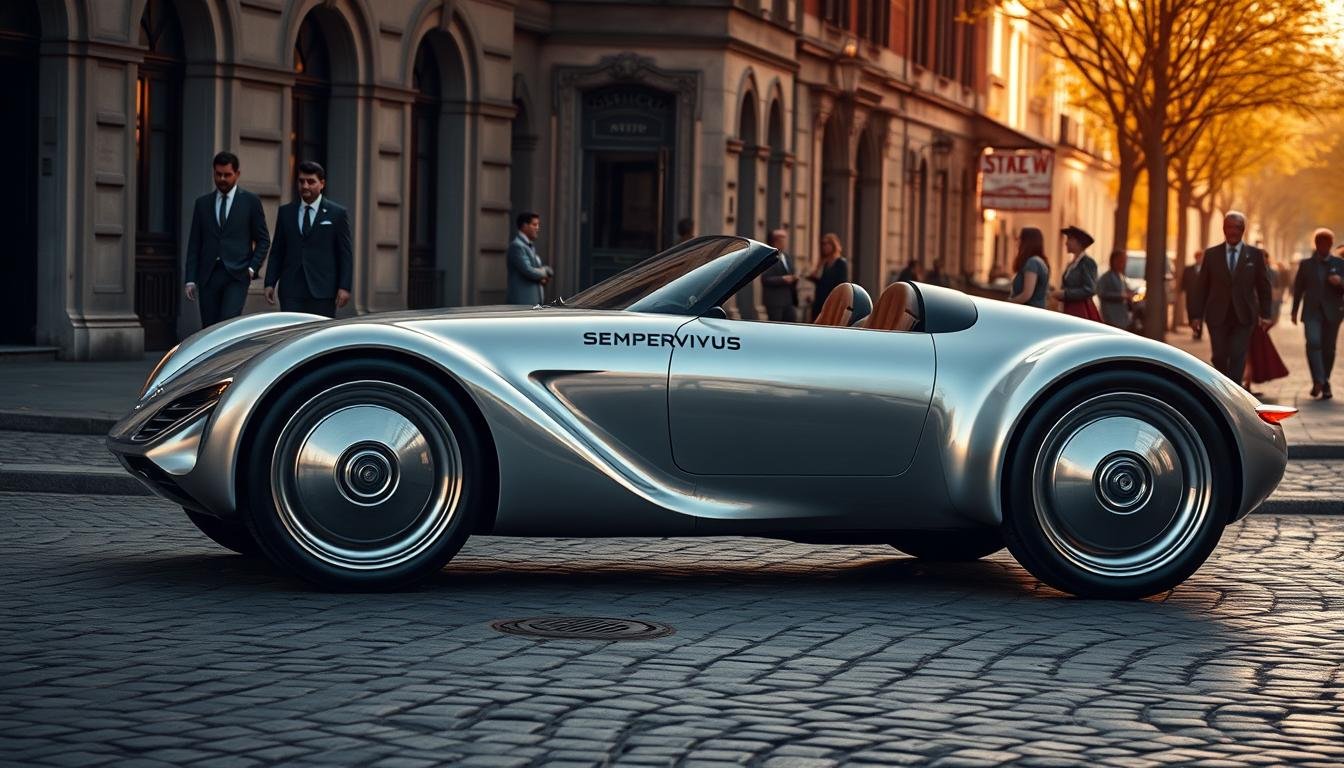

1900 Porsche Semper Vivus: The World’s First Hybrid Car That Was Light Years Ahead
The 1900 Porsche Semper Vivus was a groundbreaking car that changed the game before Tesla or Prius. Ferdinand Porsche created this vehicle, mixing electric motors with gasoline engines. It was the first full-hybrid car, named “Always Alive” in Latin, showing its advanced power source blend.
At a time when cars mostly used gasoline, the porsche semper vivus hybrid stood out. It had two electric hub motors in the front, each weighing 595 pounds. A gasoline engine powered a generator to charge batteries, similar to today’s hybrids like the Porsche Taycan. It was introduced in 1900 at the Paris World Exhibition, marking a new era in car technology.
The semper vivus’s impact is seen in Porsche’s engineering today. Its all-wheel drive version carried 1.8 tons of batteries, showing early efforts in green mobility. Though it was not widely adopted, its ideas paved the way for today’s hybrid cars, showing ferdinand porsche hybrid ideas were ahead of their time.

Key Takeaways
- The 1900 porsche semper vivus was the world’s first hybrid car, combining electric and gasoline power.
- Ferdinand Porsche pioneered porsche semper vivus hybrid tech, predating modern hybrids by over a century.
- Its drivetrain used electric hub motors, a generator, and batteries, solving range issues with innovative engineering.
- Only a few original Lohner-Porsche models survive, with a replica displayed at the Vienna Technical Museum.
- This early electric vehicle highlights porsche history as a leader in sustainable automotive innovation.
The Revolutionary Birth of the 1900 Porsche Semper Vivus
The 1900 hybrid car changed how we think about cars. Ferdinand Porsche’s semper vivus technology mixed electric motors with gasoline generators. This solved old problems of range and power.
The car’s name, “Semper Vivus,” means “Always Alive.” It shows Porsche’s dream of a car that never stops. This idea is key to porsche engineering history.

What “Semper Vivus” Means and Why It Matters
“Semper Vivus” was Porsche’s way to beat EV limits. By using gasoline engines to extend range, the car had constant power. This honored the first electric porsche models.
The name also shows how this early porsche innovation was ahead of its time.
Ferdinand Porsche’s Vision Beyond His Time
At Lohner & Co., Porsche started something new. His 1900 hybrid car had two front-wheel motors, each with 2.5 PS. It could go 32 km/h.
These porsche semper vivus specs were groundbreaking, even back then. They showed electric and gasoline power could work together, a concept far ahead of its time.
The Problem Porsche Was Trying to Solve
Early EVs had short ranges and gas engines were hard to start. Porsche found a solution. A gasoline generator recharged batteries on the move.
This semper vivus technology made hybrids a real solution, not just dreams. It made cars better than anything before by decades.
Ferdinand Porsche: The Innovative Mind Behind the First Hybrid
Ferdinand Porsche started with a spark of curiosity. At 18, he lit up his family’s home with electricity in 1893. This was the beginning of his love for electric power.
His passion led to the porsche ev origins with the 1898 Egger-Lohner C.2 Phaeton, or the “P1.” This mixed electric and mechanical genius. It set the stage for the 1900 called the Semper Vivus.
The Semper Vivus had a system. It combined electric and gasoline power, a leap forward for its time.
Porsche’s designs focused on efficiency. His for the Semper Vivus used electric hub motors. This layout is seen in today’s EVs.
This showed Porsche’s vision of combining technologies. His work in electric propulsion, from home to the P1’s 25 km/h speed, set the stage for Porsche’s future.
Despite limited resources, Porsche’s vision never wavered. The Semper Vivus’s system was a testament to his problem-solving. It merged battery and combustion systems.
This was more than a prototype—it was a blueprint. Over a century later, Porsche’s vision lives on in cars like the Taycan. It shows his engineering foresight remains key to car innovation.
Engineering Marvel: How the Semper Vivus Hybrid System Worked

The hybrid drivetrain 1900 in the Semper Vivus changed car engineering. It combined two electric hub motors with gasoline engines. This porsche hybrid revolution used a semper vivus tech layout to balance power.
This layout used batteries and generators. It’s a concept found in today’s plug-in hybrids.
The Dual Electric Hub Motors
The porsche electric hub motor was mounted on the front wheels. It eliminated the need for gears and transmissions. Each motor provided instant torque, a feature in today’s electric cars.
Power went directly to the wheels. Any extra energy was stored in batteries.
Gasoline Engines as Range Extenders
The Semper Vivus had two porsche fuel innovation single-cylinder engines. These engines were 2.5 hp each and powered generators. They never drove the wheels but charged batteries or ran generators.
This setup solved the problem of short battery life in the 1900s. It didn’t cut down on driving range.
The Revolutionary Generator System
Generators in the Semper Vivus did double duty. They converted engine power into electricity and could start the gas engines. This made the Semper Vivus the first hybrid vehicle invention with a serial hybrid architecture.
This layout is used in cars like the Chevrolet Volt today.
Battery Technology in 1900
Lead-acid batteries in the 1900s were bulky and had low capacity. Porsche found a solution. They used surplus generator energy to keep batteries charged.
This energy management system helped achieve a 124-mile range. It showed early porsche hybrid revolution ingenuity.
| Component | Function |
|---|---|
| Electric Hub Motors | Direct wheel power, no gears |
| Gasoline Engines | Powered generators, extended range |
| Generators | Charged batteries and doubled as starters |
| Batteries | Stored energy for peak performance |
Technical Specifications and Design Elements
The porsche semper vivus specs show a car that was way ahead of its time. It had semper vivus electric wheels with two hub motors, each giving 2.7 hp. Plus, it had two porsche 1900s prototype gasoline engines, each with 2.5 hp. This mix of electric and gas power made it fast, reaching 22 mph, and it could go 124 miles on a single charge.
It weighed 2,646 lbs, but its design was light and efficient. It had a wooden frame and a new 44-cell battery, replacing the old 74-cell one.

- Engine: 2 De-Dion-Bouton single-cylinder units
- Electric output: 2.7 hp per wheel (total 10.8 hp)
- Range: 124 miles on electric alone
- Weight: 1,200 kg (2,646 lbs)
- Powertrain: Hybrid system with gasoline engines as range extenders
Despite being a porsche mechanical marvel, the porsche 1900s prototype had its issues. Its heavy weight was hard on early tires, and the exposed engines needed constant upkeep. The battery swap saved space but cut down on power.
Ferdinand Porsche focused on making it work, not on making it look good. Though it never went into mass production, it paved the way for today’s hybrids. The Semper Vivus shows how early car makers were trying to mix electric and gas power, years before it became common.
A Century Before Its Time: Comparing the Semper Vivus to Modern Hybrids

The first hybrid in the world was a game-changer. Ferdinand Porsche’s 1900 design was a serial hybrid. It used gasoline engines to charge batteries, which then powered electric motors.
This idea is seen in today’s plug-in hybrids, like the Chevrolet Volt. It shows the semper vivus forward thinking was way ahead of its time.
| Feature | Semper Vivus (1900) | Porsche Panamera S Hybrid (2010) |
|---|---|---|
| Power Source | Two 3.5-hp petrol engines as generators | 4.8L V8 + 47-hp electric motor |
| Electric Drive | In-wheel motors | Integrated electric motor in transmission |
| Range | ~80 km electric-only | 6.8L/100km fuel efficiency |
Modern hybrids take inspiration from the semper vivus electric hybrid. Its use of combustion to extend range is seen in cars like the Toyota Prius. Even Audi’s 1989 Duo concepts followed this serial hybrid logic.
The hybrid tech history shows Porsche’s early vision influenced today’s electric cars. The Semper Vivus’s battery-electric wheel motor combo is similar to Tesla’s and BMW’s EVs.
The porsche alternative power approach is now standard in Porsche’s plug-in hybrids. Even with early 20th-century limitations like lead-acid batteries, Ferdinand Porsche tackled today’s efficiency challenges.
Today’s hybrids honor the legacy of the semper vivus vs modern hybrids. The 2011 recreation showed its design’s lasting appeal. From the 1901 Lohner-Porsche Mixtees to the 2023 Taycan, the idea of combining combustion and electric power remains.
The Historical Context: Automobiles at the Turn of the Century
In 1900, cars were just early automotive engineering tests. Most cars needed to be cranked by hand, and roads were not modern. Hybrid cars timeline started here, with ferdinand porsche genius leading the way with the Semper Vivus. This time was full of competition between steam, electric, and gasoline cars, each facing issues with reliability and range.

- Steam engines: Slow and cumbersome
- Electric cars: Limited range
- Gasoline engines: Difficult to start, unreliable
Porsche’s vintage car engineering fixed these problems. The Semper Vivus mixed gasoline engines with electric motors, skipping old drivetrain designs. This idea is seen in Porsche’s porsche future roots like the 2010 Cayenne S Hybrid. At the 1900 Paris World’s Fair, it showed early vehicle innovation, but many didn’t see its value. High costs and public doubt slowed its use, but its design ideas live on in today’s hybrids.
Even though it was unknown, Porsche’s hybrid set the stage for green cars. The Semper Vivus’s 1900 debut and the Cayenne S Hybrid’s 2010 launch show a century of hybrid car history. This ferdinand porsche genius is a key part of car history, showing that early vehicle innovation can shape the future.
Challenges and Limitations of Early Hybrid Technology
The ferdinand porsche inventions were groundbreaking, but the semper vivus had its flaws. Its heavy frame put a lot of stress on the tires. The semper vivus battery tech used old-fashioned lead-acid batteries, which were big and didn’t go far.
These porsche engineering milestone ideas were ahead of their time. But they didn’t fit well with the 1900s. The car’s vintage hybrid porsche design focused on technology, not comfort. This made it hard to make many of them.

Materials and Manufacturing Constraints
The porsche rolling innovation used a lot of heavy steel and cast iron. This made the car too heavy for its tires and engine. The exposed engines and handmade parts also made it expensive to make.
Battery Limitations of the Era
Lead-acid batteries were not very good at storing energy. They needed to be charged often. The semper vivus battery tech had short ranges and didn’t last long. This made it hard to keep the first ev hybrid running well.
Public Reception and Understanding
In 1900, most people had never seen a car, let alone a vintage hybrid porsche. It was hard for dealers to explain how the electric and gas parts worked together. The idea of an early hybrid car success was hard for people to understand back then.
From Prototype to Legacy: The Journey of the Semper Vivus
The Porsche concept 1900 started as a test vintage hybrid car. It showed Ferdinand Porsche’s porsche 1900 engineering. His work led to the Lohner-Porsche Mixte, a porsche legacy model made until 1915.
This hybrid model origins had a 5.5L gasoline engine and electric motors. But, its high cost limited sales to 65 units.

Even though its porsche hybrid story was forgotten back then, the Mixte’s design inspired today’s hybrids. Porsche’s early trials showed that even new ideas can change history. Now, the Semper Vivus is seen as a guide for green transport. It shows that innovation takes time to be recognized.
The Lost Years: Why the Semper Vivus Didn’t Immediately Change the World
The porsche mechanical marvel known as the Semper Vivus faced many challenges. Despite its semper vivus uniqueness, Ferdinand Porsche’s first build was ahead of its time. But, market trends and technology delays slowed its impact.

Economic Factors That Hindered Adoption
The Semper Vivus was pricey, costing around $98,000 today. Its battery technology made upkeep costly. Also, it needed special parts, making mass production hard.
People chose cheaper gasoline cars instead. This made the Semper Vivus less popular.
The Rise of Affordable Gasoline
By 1900, gasoline was cheap and plentiful. Gasoline engines got better, with more range and lower costs. This made the Semper Vivus’s hybrid idea less appealing.
By 1910, gasoline cars were the norm. They left hybrids behind.
Competing Technologies of the Era
Gasoline engines became more reliable with electric starters. The Semper Vivus’s hybrid system was overshadowed by lighter gasoline cars. Ferdinand Porsche’s vision was clear, but timing was everything.
After World War I, focus shifted to war production. Hybrid research was forgotten until the 1990s Prius.
Rediscovery and Recognition: The Semper Vivus in Modern Times
In 2007, the Porsche Museum started a three-year project to bring back the semper vivus museum car. By 2010, engineers had made a replica of the 1900 . They used old blueprints and Ferdinand Porsche’s notes. Now, this pioneer is a symbol of in Stuttgart.

Today, experts see its forward-thinking design. The Semper Vivus’s has grown as hybrids like the Toyota Prius became popular. Its 124-mile range and dual-motor system showed early could power cars without just gasoline.
| Spec | 1900 Original | 2010 Replica |
|---|---|---|
| Power | 5 HP gas + 10.8 HP electric | Recreated with period-accurate components |
| Top Speed | 22 mph | Matching original specs |
| Weight | 1,200 kg | Exact reproduction |
Now, the attracts many visitors at the Porsche Museum. It shows a link between the past and today. Its story proves that ideas can come back years later.
The Meticulous Recreation: Building the Semper Vivus Replica

Porsche worked hard to make a perfect copy of the 1900 semper vivus replica. They had to use just one old drawing and blurry photos. This vintage hybrid engineering challenge was like solving a mystery.
They used 3D scans and models to fill in the missing pieces. This way, they brought Ferdinand Porsche’s dream to life.
“Every bolt told a story,” said Hubert Drescher, the project’s leader. “We married 21st-century tools with 1900s ingenuity.”
Research and Documentation Challenges
Archivists looked through old records to understand the hybrid powertrain evolution. They guessed engine details from old photos and used lasers to figure out the car’s size.
Only one old technical drawing was left, so they had to guess about the battery and wiring.
Finding Period-Correct Components
Restorers searched for old engine parts, even finding some in old factories. Here’s a list of some key parts:
| Component | Source |
|---|---|
| Gasoline engine | Reproduced using 1900 blueprints |
| Battery cells | Lead-acid design, replicated with period materials |
| Hub motors | Modern alloys matched 1900 specs |
The Modern Engineering Team
Porsche’s porsche technology leader team used computer software to design the hybrid concept history. Hubert Drescher’s team found leather straps from the 1800s and made gears to exact 1900 standards.
They created a semper vivus historical review that looks just like Ferdinand Porsche’s original hybrid invention date dream.
Now, this semper vivus replica shows how old ideas meet new technology. It’s a lesson for today’s electric car makers.
Porsche’s Hybrid Legacy: From Semper Vivus to Taycan
The porsche history fact of Ferdinand Porsche’s 1900 Semper Vivus started the hybrid journey. Over a century later, Porsche brought back this dream, mixing power with green tech. The 2010 remake of the Semper Vivus, with its semper vivus original specs, shows how Porsche connected its early porsche mobility beginnings with today’s porsche sustainable future.

Ferdinand Porsche’s ferdinand porsche electric ideas led to today’s hybrids. In 2011, the Cayenne S Hybrid was Porsche’s first hybrid car, just like the Semper Vivus. By 2015, the Panamera E-Hybrid and Cayenne E-Hybrid kept this tradition alive. The 918 Spyder (2013) and 919 Hybrid racecar showed hybrids can be fast and efficient, just like Porsche’s spirit.
- 2011 Cayenne S Hybrid: Launched 111 years after the Semper Vivus, it used gas-electric power for 25% better fuel efficiency.
- 2019 Taycan: Fully electric, it inherits the Semper Vivus’s electric motor integration, now optimized with modern battery tech.
- Today’s plug-in hybrids: From Cayenne to Panamera, they balance porsche hybrid comparison metrics with Ferdinand’s original performance ethos.
Today’s Taycan and E-Hybrid models show Porsche’s dedication to a porsche sustainable future. They prove Ferdinand’s vision lives on. By celebrating the Semper Vivus’s semper vivus historical value, Porsche’s team makes sure every electric motor and hybrid system respects its past. They aim for a future without carbon.
Museum Life: Where to See the Semper Vivus Today
The historic porsche replica of the 1900 Semper Vivus is now at the Louwman Museum in The Hague, Netherlands. This electric porsche 1900 was a first in hybrid technology. It was bought at the 2016 Amelia Island Concours d’Elegance by Evert Louwman for $483,400.

Visitors can see this engineering marvel in person or online. The Porsche Museum in Stuttgart sometimes shows it. It’s also featured in special events like the 2024 North Carolina Museum of Art’s “Porsche By Design”.
Virtual tours and books like Semper Vivus: The Birth of Hybrid Technology let everyone explore. The Louwman Museum and Porsche’s site have detailed histories. This lets fans worldwide connect with Ferdinand Porsche’s vision.
The Engineering Lessons We Can Learn from the Semper Vivus
The Semper Vivus was more than a curiosity of its time. It offers insights into solving today’s challenges. Its semper vivus innovation combined electric propulsion vintage systems with gasoline engines. This blend is studied today for its efficiency.
Ferdinand Porsche’s genius car showed that hybrid principles could overcome early porsche battery history hurdles. This lesson is echoed in today’s electric vehicle advancements.
efficiency principles that remain relevant>
Key lessons include:
- Electric motor efficiency: The car’s hub-mounted motors delivered maximum torque, a strategy seen in modern AWD EVs.
- Energy recuperation: Its generator setup pioneered regenerative braking, now standard in hybrids.
- Range extender system: Gas engines charged batteries, not powering wheels—a design used in hybrids like the Chevrolet Volt.

innovative thinking in resource constraints>
With 1890s materials, Porsche optimized porsche fuel and electric integration. Today, engineers face similar challenges, like battery cost or rare mineral scarcity. The Semper Vivus shows how creative engineering can overcome material limits, proving innovation thrives under pressure.
dual-power systems beyond cars>
The semper vivus engineering inspired more than just cars. Modern applications include:
- Marine vessels using hybrid propulsion for silent operation.
- Backup power grids combining diesel generators with batteries.
- Electric buses with range-extending generators for long routes.
Ferdinand Porsche’s 1900 design remains a blueprint for balancing efficiency and reliability. This legacy fuels everything from ferdinand porsche genius car descendants like the Taycan to renewable energy storage systems.
How the Semper Vivus Predicted Our Sustainable Transportation Future
The Semper Vivus had a dual fuel system, a concept seen in today’s porsche dual fuel car designs. It was made over a century ago, before modern hybrids existed. It combined electric and gasoline power, solving the range problems that porsche vs early evs faced.
Today, it’s a semper vivus collector item and a key part of hybrid car exhibit history.

| Technology | Semper Vivus (1900) | Modern Hybrids |
|---|---|---|
| Power Source | Gasoline engines + electric hub motors | Electric motors + gasoline engines |
| Range | Limited by early batteries | Extended by advanced lithium-ion tech |
| Innovation | First functional serial hybrid | BMW i3 REx, Porsche Taycan |
Semper vivus documentation shows Ferdinand Porsche’s drive for efficiency. His porsche electrification vision was to merge power sources. This idea is key to the porsche innovation century.
Modern hybrids, like the Porsche 918 Spyder, follow this idea. They combine 500 hp engines with electric motors. The Semper Vivus’s hub motors are seen in Tesla’s wheel-based prototypes, showing its forward-thinking design.
Today, the hybrid car exhibit at the Porsche Museum celebrates this legacy. From its 1900 start to today’s EVs, the Semper Vivus is a model for balancing green and performance. Its ideas live on in collector items and global plans for electric cars, showing that innovation often comes full circle.
Conclusion: The Lasting Impact of Ferdinand Porsche’s Hybrid Vision
The 1900 Porsche Semper Vivus shows Ferdinand Porsche’s early design genius. It was the first hybrid car, mixing gasoline and electric power. This idea was ahead of its time, showing Porsche’s leadership in car technology for over a century.
Ferdinand’s work in 1900 was a big step towards today’s green cars. Now, Porsche makes cars like the Taycan and Mission E, showing its commitment to the environment. By 2022, Porsche will spend over 6 billion euros on electric cars, following its founder’s vision.
From the Semper Vivus to today’s electric cars, Porsche has always innovated. They’ve won 19 Le Mans races and made over 1 million 911s. Porsche is now focusing on making cars that are both fast and green, staying true to its founder’s dream.
FAQ
What does “Semper Vivus” mean?
“Semper Vivus” is Latin for “Always Alive” or “Forever Alive.” It shows the car’s design to beat early electric vehicle limits. It uses gasoline engines as range extenders.
Who was Ferdinand Porsche?
Ferdinand Porsche was a groundbreaking engineer. He designed the Semper Vivus in 1900. He made big steps in car tech and hybrid cars long before they were common.
How did the Semper Vivus hybrid system work?
The Semper Vivus had dual electric hub motors in the front wheels. It also had two single-cylinder gasoline engines and a generator to charge the batteries. This made it a leading hybrid car model.
What were the key technical specifications of the Semper Vivus?
The Semper Vivus had two De-Dion-Bouton single-cylinder engines (each making 2.5 hp). It had electric hub motors that output 2.7 hp per wheel. It could go up to 22 mph, travel 124 miles, and weighed about 1,200 kg (2,646 lbs).
Why didn’t the Semper Vivus have immediate commercial success?
High production costs and early battery tech limits were big factors. The public was also not used to hybrid cars. Gasoline engines became more affordable and practical during that time.
What is the significance of the Semper Vivus in automotive history?
The Semper Vivus is the world’s first working hybrid car. It showed early engineering that mixed electric and gasoline power. It has shaped today’s hybrid and electric car designs.
Where can I see the Semper Vivus today?
You can see the Semper Vivus replica at the Porsche Museum in Stuttgart, Germany. It also shows up at car museums and events, like vintage car shows and innovation exhibitions.
How does the Semper Vivus relate to modern hybrid vehicles?
The Semper Vivus laid down key engineering ideas. These include the serial hybrid setup and dual-power systems. These ideas are seen in today’s hybrids, like the Chevrolet Volt and Toyota Prius.
What engineering lessons can be drawn from the Semper Vivus?
The Semper Vivus shows how electric motors can be efficient. It also shows the value of creative thinking and dual-power systems. These lessons are important today in engineering.
What factors led to the revival of interest in the Semper Vivus?
Interest in the Semper Vivus grew with the rise of modern hybrids and electric cars in the late 1990s. This made people look back at Ferdinand Porsche’s vision and its impact on today’s cars.