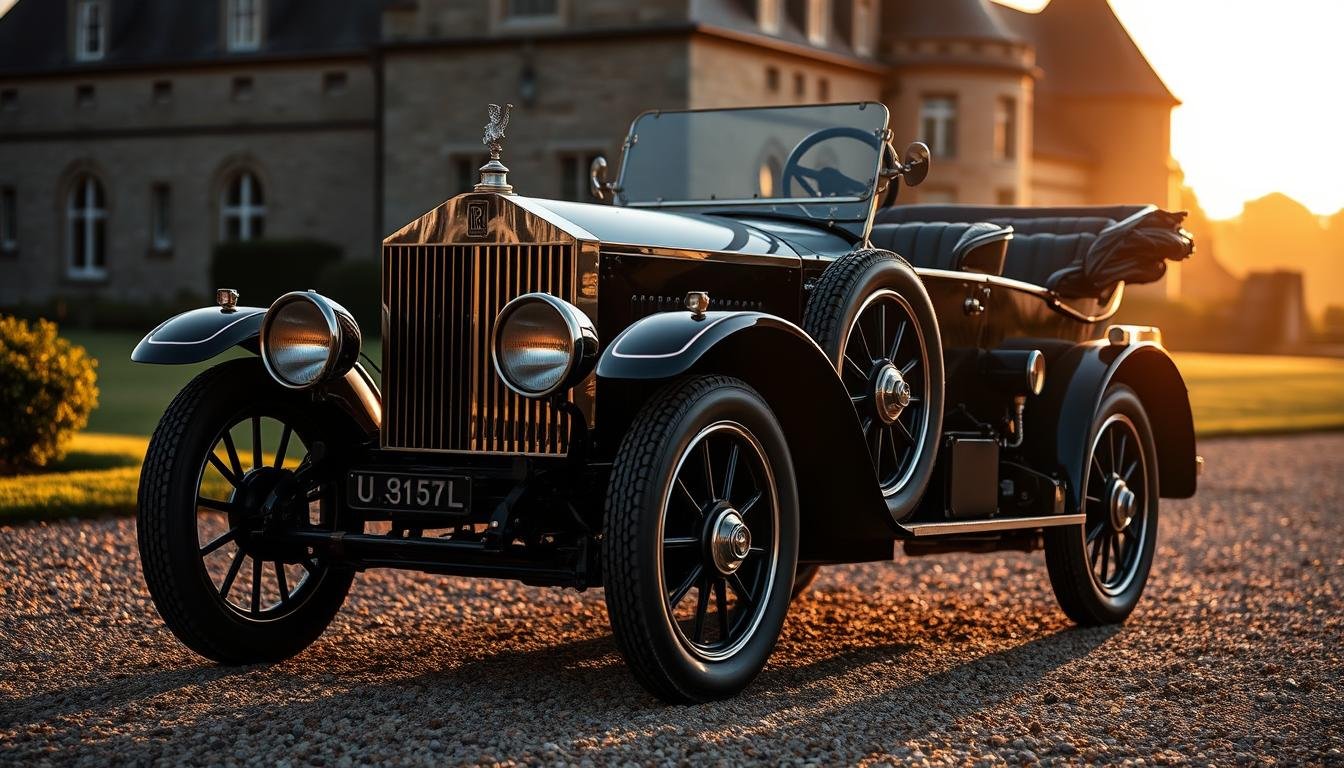

1907 Rolls-Royce Silver Ghost: The Car That Made the World Whisper

The rolls-royce 40/50 hp Silver Ghost debuted in 1907, marking a big step in car innovation. This rolls-royce vintage car was known for its reliability and luxury. During a 14,932-mile test, it needed just a £2.13 tap replacement, showing its top-notch vintage rolls-royce quality. By 2019, one sold for $75 million, beating the Ferrari 250 GTO’s $48 million record.
In 1925, it was named the silver ghost 1907, becoming the first Rolls-Royce to represent perfection. Autocar named it “Best Car in the World,” solidifying its legacy. Over 7,800 were made, with 6,173 in England. Its 7.0-liter engine ran smoothly for 24,000 km, reaching the peak of rolls-royce history’s engineering.
First priced at $5,000, its value jumped to $10,000 after the war, showing its worth as a early rolls-royce models gem. Today, it’s valued at $200 million, showing its lasting charm as a rolls-royce first car that combined luxury and reliability.
Key Takeaways
- Completed 14,932-mile testing with only a £2.13 repair cost.
- Recognized as the “Best Car in the World” by Autocar upon release.
- Valued at $200 million, it’s the most expensive rolls-royce vintage car ever.
- Renamed “Silver Ghost” in 1925 to distinguish from later Phantom models.
- Produced for 20 years, it set standards for rolls-royce history and modern luxury cars.
The Birth of an Automotive Legend

In 1904, Charles Stewart Rolls and Sir Frederick Henry Royce teamed up. They wanted to change car engineering forever. Their dream was to create the perfect car, blending Rolls’ business skills with Royce’s engineering precision.
By 1906, they had made Rolls-Royce Limited official. This marked the beginning of a long history of innovation.
The Rolls-Royce Partnership: Visionaries Behind the Masterpiece
“Take the best there is and make it better.”
This saying was their guide. Rolls, known for racing, brought excitement to the brand. Royce, a self-taught engineer, focused on every detail of their cars.
Their first car, the 10hp model, was made in 1904. But the real start of Rolls-Royce was the Silver Ghost in 1907.
Early 20th Century Automotive Landscape
In the brass era, cars were often weak and noisy. Roads were bad, and cars could break down easily. Rolls-Royce aimed to change this.
Other cars failed tests, but Rolls-Royce wanted to be different. They focused on making cars that were reliable and strong.
The Silver Ghost’s Conception and Initial Design Goals
Claude Johnson wanted a car that showed Rolls-Royce’s best. The 1907 prototype, AX 201, had a big engine and a silver finish. It went 15,000 miles without a problem, showing Rolls-Royce’s commitment to quality.
The Silver Ghost was made to be quiet and strong. It set new standards for Rolls-Royce cars. This car marked the beginning of Rolls-Royce’s lasting legacy in the car world.
Understanding the 1907 Rolls-Royce Silver Ghost
The rolls-royce silver ghost specs of the 1907 model set a high standard for cars for years. It was called the 40/50 HP, but its name didn’t match its power. The silver ghost 1907 had a 7.0-liter engine, growing to 7.4 liters by 1910. It had a 135.5-inch wheelbase and weighed 3,300 lbs, showing beauty and engineering.
Compared to its predecessor, the 30 HP, the 1907 Rolls-Royce Silver Ghost was better in many ways. Key 1907 rolls-royce silver ghost specs include:
- Engine: 7,036cc (429.4cid) to 7,428cc (453.3cid) over its lifespan
- Power output: 48bhp initially, rising to 85bhp by 1925
- Production span: 1906–1926 with 7,874 total units
| Year | Engine Size | Power | Key Features |
|---|---|---|---|
| 1907 | 7.0L | 48bhp | Manual 3-speed transmission |
| 1913 | 7.4L | 70bhp | 4-speed transmission introduced |
| 1920 | 7.4L | 85bhp | Electric lighting and starters |

These rolls-royce historical specs show its reliability in the 1907 silver ghost 1907 era. A 15,000-mile test showed it was very durable, needing only oil changes. By 1921, the American models cost $11,750, about $207,000 today. This made it a top choice for cars.
Engineering Excellence: The 40/50 HP Powerplant
The Silver Ghost’s heart was its rolls-royce 7.0 liter engine, a 40/50 hp inline-six. It was a game-changer in the car world. This rolls-royce inline-six engine had three cylinder blocks, no head gaskets, and was incredibly durable.
It produced 48-50 horsepower at 1,500 RPM. It focused on smoothness, not just power. This made it reliable for the famous 15,000-mile trial.

The Revolutionary 7.0-Liter Inline-Six Engine
Each engine block was a work of rolls-royce precision engineering. It had aluminum crankcases for less weight and twin spark plugs for better combustion. It had seven main bearings and a low-pressure cooling system for long-lasting use.
Lawrence of Arabia even used it in the desert. Its rolls-royce quiet operation was a big plus.
Precision Engineering: Tolerances and Manufacturing Standards
Every part was checked for quality at Rolls-Royce’s Derby factory. Bearings were hand-scraped to very tight tolerances. Gears were matched by hand to avoid any backlash.
This rolls-royce hand-built process took six to eight months per engine. It showed rolls-royce craftsmanship that no one else could match. The engine was assembled with such care that it ran almost vibration-free.
The Silent Operation That Stunned the World
People called it the silver ghost whisper. It was a rolls-royce silent engine so quiet, a coin could balance on it at idle. This rolls-royce mechanical silence came from balanced crankshafts and special engine mounts.
This made the ride rolls-royce silent and unmatched in its time. Testers were amazed by the quiet cabin. This quietness is a key feature of luxury cars today.
Craftsmanship Beyond Compare: Hand-Built Perfection
Every Silver Ghost was a rolls-royce hand-built marvel, taking six to eight months to complete. The body’s preparation alone demanded over 55 hours. Craftsmen used ultra-violet light to detect flaws, then hand-sanded and polished surfaces. This rolls-royce craftsmanship redefined automotive luxury, ensuring rolls-royce quality unmatched by others.

Specialized artisans—coachbuilders, leather workers, and metal finishers—crafted each component with precision. Engines were rolls-royce handcrafted, with tolerances measured in microns. Multi-stage inspections ensured perfection, a standard that endures in modern bespoke rolls-royce handmade car models. This rolls-royce excellence remains the brand’s cornerstone, proving hand-built mastery defines Rolls-Royce’s legacy.
Artisans spent hours refining wood, stitching leather, and aligning engine parts to exacting standards. Each phase faced rigorous checks—flaws led to rejection, ensuring only flawless vehicles left the factory. Over a century later, this ethos persists: modern Rolls-Royce models integrate bespoke elements, honoring the Silver Ghost’s legacy of rolls-royce craftsmanship. The result: a timeless standard of luxury and precision.
The Silver Finish: More Than Just Aesthetics
TheSilver Ghostnickname came from its beautiful look and quiet ride. In 1907, Claude Johnson picked chassis AX 201 to show off Rolls-Royce’s skills. It was painted inaluminumand had silver-plated parts, showing the brand’s attention to detail.
The name “Silver Ghost” came from its quietness and shiny look. This made thesilver ghost nickname famous in car history. It turned one car into a symbol of top quality.
“The best car in the world”

Therolls-royce silver finish needed careful upkeep. The paint was polished by hand, making it shine like a mirror. Thisrolls-royce aesthetic design made the car glow in the sun, standing out on dark roads.
Thesilver ghost visual impact was huge: it seemed to float. Itsrolls-royce timeless design stayed ahead of trends.
Today, Rolls-Royce cars keep this tradition alive. The 2020 Ghost has paint with real silver, just like AX 201. Over a century later, therolls-royce silver finish is a sign of luxury, showing that beauty and engineering go hand in hand.
Redefining Luxury: Interior Design and Passenger Experience

Inside the Silver Ghost, every surface spoke of exclusivity. The interior combined silver ghost leather with hand-stitched seams. These were made from hides by Connolly Brothers. Rolls-royce luxury materials like Wilton wool carpets and polished brass added to the opulence.
Each part—wood veneers, stitching, and metalwork—showed perfection after thousands of hours. This was the result of endless attention to detail.
Opulent Materials and Meticulous Detailing
Connolly leather upholstery required perfection. Only flawless hides were used. Up to ten hides were matched for a seamless finish.
Wood inlays were aligned by hand, and nickel accents were polished to a mirror sheen. Even the carpets, made from hand-tufted wool, matched European haute couture’s luxury.
“The loudest sound is the beating of your heart.” The cabin’s rolls-royce smooth ride was matched by its silence. This was thanks to sound-dampening innovations. Passengers enjoyed unmatched comfort—ergonomic seats, climate controls, and a lack of mechanical din.
Customization Options for the Discerning Client
Rolls-royce customization allowed clients to create silver ghost bespoke designs. Coachbuilders like HJ Mulliner and Park Ward made custom bodies—convertibles, limousines, or tailored interiors. Rolls-royce personalization included embroidery, wood finishes, and custom storage solutions.
These creations now sell for six figures at auction. They prove their timeless appeal.
The Passenger Experience: Comfort in a New Era
The silver ghost passenger experience started with closing its vault-like doors. Aromatic leather, climate-controlled environments, and a rolls-royce smooth ride made journeys retreats. Seats offered rolls-royce comfort even over rough roads.
Bespoke upholstery choices made every detail a statement of status.
The Legendary 15,000-Mile Reliability Trial
In 1907, the Silver Ghost started a historic silver ghost 15000 miles journey. It was called the rolls-royce famous trial. This rolls-royce endurance run covered 15,000 miles, watched by the Royal Automobile Club.
The car made 27 round trips between London and Glasgow. It faced potholes, rain, and icy roads. Yet, it showed rolls-royce reliability like no other car of its time.

Over 15,000 miles, the Silver Ghost needed only £2.13 in repairs after 7,000 miles. This showed its rolls-royce reliability record. The only issue was a blocked fuel tap, not engine failure.
After the Scottish Reliability Trials, it kept going without stopping. It won praise for its engineering. People noted it could do 5,000 miles in a month without breaking down, a feat no one else could match.
This silver ghost testing made Rolls-Royce a leader in car durability. The car did well in trials like the 1913 Alpine Trial, where four Ghosts won top spots. It proved luxury and rolls-royce reliability could go together. This made the Silver Ghost known as the “best car in the world.”
Performance Metrics: How the Silver Ghost Outpaced Its Era
The Silver Ghost was powered by a 7.4-liter inline-six engine. It changed rolls-royce performance specs when cars were just starting to evolve. It reached a silver ghost top speed of 52.94 mph in 1907. It also accelerated to 30 mph in 17.3 seconds, surprising people who thought luxury meant slow.
The rolls-royce power delivery was amazing. It had smooth, linear torque from its six-cylinder engine. This made it easy to move, even on bumpy roads.

The car was also very efficient. It got 23.25 miles per Imperial gallon, allowing over 300 miles on a full tank. This made it perfect for silver ghost long distance trips. Its silver ghost efficiency came from precise carburetion and low friction.
Drivers loved the rolls-royce smooth suspension. It handled potholes and cobblestones well. The silver ghost handling was also great, keeping it stable at high speeds despite its 2,800-pound weight.
“The best car in the world,” declared Autocar magazine, citing the Silver Ghost’s blend of rolls-royce high performance and refinement.
On roads with potholes and gravel, the Silver Ghost was impressive. Its rolls-royce steering was heavy but precise. The silver ghost in motion felt steady, even at its silver ghost speed capabilities.
These features, along with its rolls-royce fuel consumption metrics, made the Silver Ghost legendary. It balanced rolls-royce power delivery with practicality. It offered comfort and confidence, whether you needed speed or endurance.
“The Best Car in the World”: How the Title Was Earned
Claude Johnson wasn’t wrong when he called the rolls-royce best car in the world. The Silver Ghost’s silver ghost reputation started with a 1907 reliability trial. This trial was a 15,000-mile journey that broke all records.
After the test, only 0.001-inch wear was found on key parts. This showed the rolls-royce excellence. The Silver Ghost became a rolls-royce global symbol of top-notch cars.

“The Rolls-Royce engine ran smoother than a Swiss watch,” noted Motor magazine in 1908. “Its quiet operation and power left no doubt.”
The Silver Ghost had a 7.0-liter six-cylinder engine, making 48bhp. During the trial, a penny balanced on edge at 1,600 RPM. This showed its power.
Competitors like Napier couldn’t match the Silver Ghost’s fuel efficiency. Even in Austrian Alpine trials, it outperformed. By 1912, four Ghosts won races, showing its rolls-royce prestige.
Over 6,000 units were made in two decades. Today, surviving cars are worth millions. This proves the lasting rolls-royce reputation. The phrase “the best car in the world” became a benchmark for all car makers.
Global Reception: How the Silver Ghost Changed Perceptions

The Silver Ghost made its mark in Europe, shaking off old views on rolls-royce british engineering. Critics thought British cars were old-fashioned. But the Silver Ghost showed them its true worth.
By 1907, it had traveled 15,000 miles with only £2 in repairs. This proved it was the best. The silver ghost in europe won over the hearts of the rich and powerful. It became a sign of luxury in cities everywhere.
Automobile Revue said, “The British have invented a new standard for automotive perfection.” This praise made Rolls-Royce known worldwide as the top in engineering.
European Response to British Engineering Supremacy
Before the Silver Ghost, France and Germany led in luxury cars. But the Ghost changed that. Its rolls-royce european reception made others rethink their designs.
German engineers took notes on its lubrication systems. Italian nobles wanted their own versions. Even doubters saw its greatness. The silver ghost in europe set a new standard for reliability.
American Markets and the Silver Ghost’s Influence
In America, the Silver Ghost aimed at the rich. By 1921, Rolls-Royce had a factory in Springfield, Massachusetts. It was for rolls-royce american buyers.
Hollywood stars and big names like J.P. Morgan chose it over others. This rolls-royce us influence changed what people thought of luxury. The silver ghost usa even starred in movies, showing it was a sign of success.
Its rolls-royce global impact was huge. By 1925, the Silver Ghost had changed the world’s view of British engineering. Rolls-Royce’s fame has lasted for a century, thanks to the Silver Ghost.
Competitors and Contemporaries: A Comparative Analysis

When the Silver Ghost debuted in 1907, it faced rivals like Napier, Lanchester, and Mercedes in Europe. It also competed with American giants such as Packard and Pierce-Arrow. The silver ghost vs model t comparison shows different focuses. Ford’s Model T aimed for low cost, while Rolls-Royce focused on quality.
The Silver Ghost had a 7.0-liter engine and 70 horsepower. This made it better than its rivals in durability tests.
- Silver Ghost vs Model T: The Ghost won a 15,000-mile reliability test without any failures. The Model T had many mechanical problems.
- Rolls-Royce vs Bentley: Bentley came later, but the Ghost was ahead in quality. It had a 0.01mm tolerance standard that no rival could match.
- Silver Ghost competitors like the 1907 Mercedes 70/90 hp couldn’t match the Ghost’s quiet operation and hand-polished parts.
“The Silver Ghost’s supremacy lies not in one feature, but in the flawless marriage of every part.” — 1912 Motor World review
Studies show the Silver Ghost was unmatched in production lifespan (1907–1925) with 6,173 units made. Its rivals, like the 1905 Napier 60/70 hp, used cast-iron blocks. The Ghost used aluminum heads, making it lighter.
The Ghost cost $4,000 (about $130,000 today). This made it more expensive than most rivals. Bentley’s 1920s models even followed the Ghost’s engineering standards. The Ghost set a new standard for luxury, showing that quality could beat mass production.
The Silver Ghost’s Influence on Future Rolls-Royce Models
The Silver Ghost’s design heritage and engineering principles set the stage for Rolls-Royce’s success. Its silver ghost legacy is seen in every Phantom’s design. This shows the rolls-royce brand foundation was made to endure.

Design Elements That Became Brand Signatures
The Pantheon grille, made with ancient Greek techniques, became a Rolls-Royce hallmark. The brand’s design signature evolved but stayed true to its roots. The Spirit of Ecstasy, added in 1911, brought uniformity to the brand.
Coach doors and long hoods from the Silver Ghost symbolize luxury. They show how rolls-royce design evolution combines tradition with innovation.
Engineering Principles That Endured Through Decades
The Silver Ghost’s rolls-royce engineering history focused on reliability, not just looks. Its engines worked flawlessly for years, showing rolls-royce timeless engineering.
Its balanced components and noise reduction shaped every Phantom’s engine. Even today, rolls-royce technical heritage ensures engines last a lifetime, just like the Silver Ghost’s did.
From the 1920s Phantom to the 2020s Architecture of Luxury, the Silver Ghost’s DNA is alive. Its engineering principles of smoothness, durability, and craftsmanship are key to every Rolls-Royce today.
Collector Status: The Silver Ghost in Modern Times

Today, fewer than 500 silver ghost cars exist, making them true treasures. These cars are worth between $180,000 and over $700,000. AX 201, the first test car, is valued at $200 million.
Even regular models are highly sought after. They are kept in museums and private collections. This shows their value as historical vehicles.
Surviving Examples and Their Astronomical Values
| Category | Details |
|---|---|
| Surviving Cars | ~400–500 of 7,874 produced |
| AX 201 Value | $200 million (2023 estimate) |
| Auction Records | $180,000–$700,000+ for most examples |
| Key Museums | Rolls-R-Royce Museum, Pebble Beach collections |
Restoration Challenges and Authenticity Considerations
Restoring a silver ghost is a big job. It needs experts who find the right parts from around the world. Ian Irwin spent 30 years on one project, finding a rare body in Australia.
“Every nut and bolt must match 1907 specifications,” said one restorer, highlighting the need for accuracy.
Today, shops spend over $2 million to get the look right. But, keeping the car original is key. The Rolls-Royce Enthuasiasts’ Club checks parts to keep the car true to its past.
Because these cars are rare, even small problems can lower their value. Restoring them is a big responsibility. It’s about keeping their history alive while making sure they work well.
For those who do it right, these cars are more than just vehicles. They are a connection to a time when cars were truly works of art.
Conclusion: The Enduring Legacy of Automotive Excellence
The 1907 Silver Ghost is a key part of Rolls-Royce’s history. It showed the brand’s commitment to excellence. Its reliability trial and powerful engine made it a symbol of quiet power and precision.
Between 1906 and 1926, over 7,800 Silver Ghosts were made. They are known for their beauty and quality. This made them a timeless classic in the world of cars.
Silver Ghost engineering set new standards for luxury cars. Its water-cooled engine and high-quality build raised the bar for car makers. Rolls-Royce continues this tradition with custom cars and long warranties.
Today, the Silver Ghost’s legacy is seen in every Rolls-Royce model. They offer handcrafted excellence and new technologies like electric cars. This shows Rolls-Royce’s dedication to quality and innovation.
Surviving Silver Ghosts sell for millions at auctions. They prove Rolls-Royce’s lasting impact on the car world. The Silver Ghost’s story is one of excellence that continues to inspire car makers today.
FAQ
What makes the 1907 Rolls-Royce Silver Ghost so significant in automotive history?
The 1907 Rolls-Royce Silver Ghost is known as “The Best Car in the World.” It was praised for its innovative engineering and luxury. These qualities set new standards in car making and made Rolls-Royce famous.
What was the partnership between Charles Rolls and Henry Royce?
Charles Rolls and Henry Royce teamed up in 1904 to start Rolls-Royce Limited. Rolls brought business skills, while Royce had engineering talent. Together, they made the Silver Ghost and showed their commitment to quality.
How did the automotive landscape in the early 1900s affect the Silver Ghost’s design?
Cars in the early 1900s were often loud and unreliable. The Silver Ghost changed this with its advanced engineering. It was quiet and reliable, making it a big improvement in car technology.
What were the key specifications of the Silver Ghost?
The Silver Ghost had a 7.0-liter engine and could go about 53 mph. It was built to last, with 7,874 made over 20 years. Its design focused on performance, reliability, and luxury.
What was the importance of the 15,000-mile reliability trial?
The 15,000-mile trial showed the Silver Ghost’s durability. It finished the journey with little maintenance and no breakdowns. This trial boosted the car’s reputation for excellence.
How did the Silver Ghost’s interior design redefine luxury?
The Silver Ghost’s interior used the finest materials like leather and carpets. It offered a luxurious ride that combined comfort with elegance. This set a new standard for luxury in cars.
Why is the nickname “Silver Ghost” significant?
The “Silver Ghost” name came from the first car, AX 201, painted silver. It symbolized the car’s quiet ride and elegant look. This made it a legendary vehicle.
How does the Silver Ghost compare to its contemporaries?
The Silver Ghost outshone cars like Packard and Mercedes in luxury and reliability. Its excellence in many areas made it a top choice in luxury cars of the early 1900s.
What is the current status of surviving Silver Ghosts in the collector market?
Many Silver Ghosts have survived and are now highly valued. Models like AX 201 are worth around $200 million. Their value shows their engineering and historical importance.
What challenges do owners face in restoring a Silver Ghost?
Restoring a Silver Ghost requires special knowledge and authentic parts. Finding skilled craftsmen and managing restoration costs are big challenges for owners today.